- Free Consultation: 866-966-5240 Tap Here To Call Us













What Is a Statute of Limitations? Deadlines Explained


If you’ve been injured in an accident or suffered harm due to someone else’s negligence, time is working against you. Every legal claim comes with a deadline, miss it, and you could lose your right to compensation entirely. This deadline is known as a statute of limitations, and understanding how it works can determine whether you recover damages or walk away with nothing.
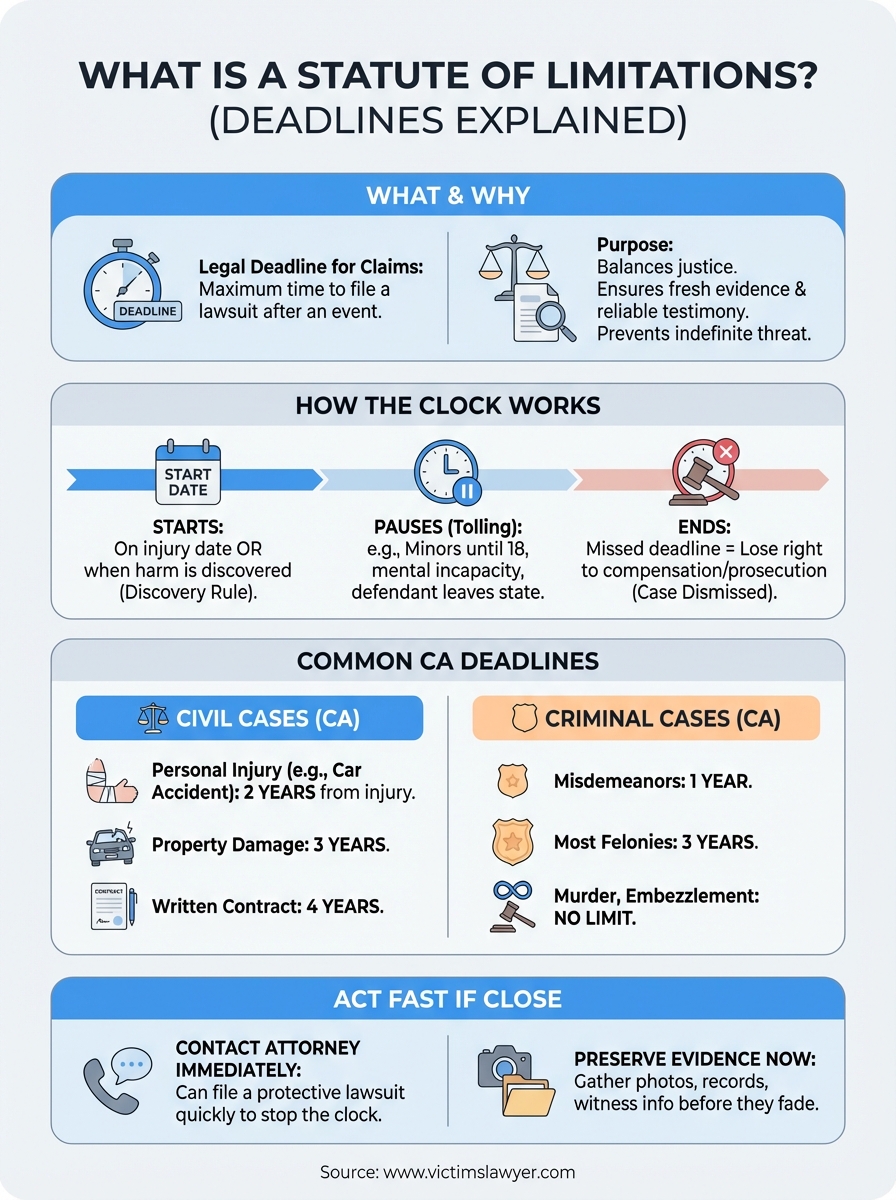
A statute of limitations is a law that establishes the maximum time after an event within which you can file a lawsuit or face prosecution. These deadlines apply to both civil and criminal matters, varying based on the type of case and jurisdiction. In California personal injury cases, for instance, victims typically have two years from the date of injury to take legal action.
At Steven M. Sweat, Personal Injury Lawyers, APC, we’ve helped injured Californians protect their claims before time runs out for over 25 years. This guide explains how statutes of limitations function, the common deadlines you need to know, and what options remain if you’re approaching a filing deadline. https://www.youtube.com/embed/t5ab-M4gRZk
Why statutes of limitations exist
These legal deadlines serve critical functions in the justice system, balancing your right to pursue compensation against the practical challenges of defending against old claims. Courts and legislatures have established these time limits to ensure that disputes get resolved while evidence remains fresh and witnesses can still provide accurate testimony. Understanding what is a statute of limitations and its purpose helps you appreciate why acting quickly after an injury matters so much.
Protection for defendants
You might wonder why the law protects those who caused your injuries, but statutes of limitations prevent defendants from facing claims indefinitely. After several years, people and businesses lose access to records, employees move on, and memories fade. Without these deadlines, insurance companies and defendants would need to maintain documentation forever, creating an impossible burden that would drive up costs for everyone.
Statutes of limitations create finality, allowing individuals and businesses to move forward without the perpetual threat of litigation hanging over them.
Preservation of evidence quality
Fresh evidence produces stronger cases and more accurate verdicts. When you file a lawsuit years after an accident, physical evidence disappears, security footage gets deleted, and witness memories become unreliable. Medical records might be destroyed after retention periods expire, and the scene of your accident could look completely different. These time limits push you to take action while your attorney can still gather compelling proof of what happened, who was at fault, and the full extent of your damages. Courts recognize that justice suffers when cases rely on stale evidence and faded recollections.
How the clock starts and stops
Understanding when your deadline begins is just as crucial as knowing what is a statute of limitations in the first place. The clock typically starts ticking on the date your injury occurs or when you discover the harm. In most California personal injury cases, your two-year window opens the moment an accident happens, but exceptions exist when injuries aren’t immediately apparent. The statute can also pause under specific circumstances, giving you additional time to file.

The trigger date
Your statute of limitations usually begins running on the date of the incident that caused your injury. If you were injured in a car accident on March 15, 2024, your deadline to file would be March 15, 2026. California law recognizes a discovery rule for cases where you couldn’t reasonably have known about your injury right away. Medical malpractice victims often benefit from this exception, as some surgical errors or misdiagnoses only become apparent months or years later.
The discovery rule can extend your filing deadline when injuries or their causes remain hidden through no fault of your own.
When the clock pauses
Certain situations cause the statute of limitations to temporarily stop running, a process called tolling. If you’re a minor when injured, the clock doesn’t start until you turn 18, protecting children who can’t file lawsuits independently. Mental incapacity also tolls the deadline until you regain competence. When a defendant leaves California after causing your injury, the time they spend out of state typically doesn’t count against your deadline.
Common time limits in civil cases
California civil law establishes different deadlines based on the type of harm you’ve suffered and what you’re seeking to recover. Understanding what is a statute of limitations means knowing these specific timeframes, as filing even one day late can end your case before it starts. Personal injury claims, property damage disputes, contract breaches, and fraud cases each carry their own deadlines, and confusing one for another could cost you everything.
Personal injury claims
You have two years from the date of injury to file most personal injury lawsuits in California. This deadline applies to car accidents, slip and fall incidents, dog bites, and medical malpractice. Product liability cases follow the same two-year window, starting when the defective product injures you. If someone’s negligence caused a loved one’s death, wrongful death claims must be filed within two years of the death, not necessarily when the underlying injury occurred.
Missing the two-year deadline for personal injury claims typically results in permanent dismissal of your case, regardless of how strong your evidence is.
Property damage disputes
Claims for damage to your vehicle, home, or other property carry a three-year statute of limitations in California. This longer window reflects that property damage often takes time to fully assess and repair costs to crystallize. Contract disputes generally allow four years to file suit, though oral agreements reduce that to two years.
Statutes of limitations in criminal cases
Criminal statutes of limitations work differently than civil ones because they protect the accused from stale prosecutions rather than the victim’s right to sue. Understanding what is a statute of limitations in the criminal context matters if you’re a crime victim seeking justice or someone facing potential charges. These deadlines dictate how long prosecutors have to bring charges, and they vary dramatically based on the severity of the offense. California law establishes specific windows for different crimes, with some serious offenses carrying no time limit at all.
Misdemeanors and felonies
Prosecutors must file misdemeanor charges within one year of the offense in California. This tight deadline covers crimes punishable by less than a year in jail, such as petty theft or simple assault. Felony cases allow more time, with most carrying a three-year statute of limitations. More serious felonies extend that window, certain sex crimes involving children provide 10 years, while others allow prosecution until the victim turns 40 years old.
Criminal statutes of limitations recognize that serious crimes deserve extended windows for law enforcement to investigate and build strong cases.
Crimes without time limits
Murder charges can be filed at any time, regardless of how many decades have passed since the crime. Embezzlement of public funds carries no deadline, reflecting California’s stance that certain offenses against society demand permanent accountability. Crimes involving DNA evidence discovered later also enjoy extended or eliminated deadlines.
What to do if you are close to the deadline
If your filing deadline approaches rapidly, you need to act immediately to protect your legal rights. Understanding what is a statute of limitations isn’t enough when time is running out, you must take concrete steps within days or even hours to preserve your claim. Missing the deadline by a single day typically means courts will dismiss your case regardless of how strong your evidence is or how severely you were injured.
Contact an attorney immediately
Call a personal injury lawyer the moment you realize your deadline is near. Attorneys can file a complaint quickly to stop the clock, even if they need more time to investigate and build your full case. Your lawyer will prioritize getting the necessary documents filed with the court before the statute expires, then continue developing your claim afterward. Don’t wait for a consultation appointment that’s weeks away, explain your urgent timeline when you call.
An experienced attorney can file a protective lawsuit within hours when necessary, preserving your right to compensation even as they continue investigating your case.
Preserve evidence now
Gather and protect any evidence you have before it disappears. Take photographs of your injuries and the accident scene, collect medical records, and write down the names and contact information of witnesses. Insurance correspondence, repair estimates, and your own notes about what happened all become critical when you’re racing against a deadline.
Key takeaways
Understanding what is a statute of limitations protects your right to compensation after an injury caused by someone else’s negligence. These legal deadlines vary significantly by case type, with California personal injury claims typically requiring filing within two years of the accident date. The clock can pause under specific circumstances like minority or defendant absence from the state, but waiting too long risks losing your case entirely regardless of your evidence quality.
Act immediately if your deadline approaches. Contact an attorney who can file protective lawsuits within hours if necessary, preserving your rights while investigating your full claim. Gather critical evidence now, including medical records, photographs, and witness information before they disappear or become unreliable.
If you’ve been injured in California and need guidance on your filing deadline, Steven M. Sweat, Personal Injury Lawyers, APC offers free consultations 24/7 to evaluate your case and protect your rights before time runs out.