- Free Consultation: 866-966-5240 Tap Here To Call Us













Pain And Suffering Settlement Examples: Amounts And Factors


Article Summary: Pain and suffering compensation represents the non-economic impact of personal injuries, often significantly exceeding medical bills and lost wages. In California, these damages address physical discomfort, emotional distress, and diminished quality of life. Settlement amounts vary widely based on injury severity: soft tissue injuries might range from $5,000 to $25,000, while catastrophic spinal or brain injuries can reach multi-million dollar figures. Insurers and attorneys typically use the multiplier method—applying a factor between 1.5 and 5 to economic losses—or the per diem approach to calculate these values. However, California’s pure comparative negligence rule and specific caps on medical malpractice claims can influence final payouts. To maximize recovery, claimants must provide objective proof through detailed pain journals, consistent medical documentation, and witness testimony. Because insurance adjusters often use proprietary software to minimize offers, building a strong evidentiary foundation is essential for securing fair compensation. Expert legal guidance helps navigate these complexities, ensuring that the human cost of an accident is fully recognized during negotiations or at trial, rather than just the documented financial losses.
When you’ve been injured due to someone else’s negligence, the physical wounds are only part of the story. The sleepless nights, anxiety, and diminished quality of life carry real value, but putting a dollar amount on that suffering isn’t straightforward. Looking at pain and suffering settlement examples gives you a practical framework for understanding what your claim might be worth and how insurance companies and courts actually assign value to non-economic damages.
At Steven M. Sweat, Personal Injury Lawyers, APC, we’ve secured hundreds of millions of dollars in verdicts and settlements for injured Californians over more than 25 years. We understand that you’re not just looking for legal theory, you want concrete numbers and real case outcomes to gauge your situation. That’s exactly what this article delivers.
Below, you’ll find actual settlement amounts across different injury types, the key factors that increase or decrease compensation, and the calculation methods attorneys and insurers use to arrive at these figures. Whether you’re dealing with a car accident, slip and fall, or workplace injury, this breakdown will help you understand what fair compensation looks like before you negotiate or step into a courtroom.
Why pain and suffering drives settlement value
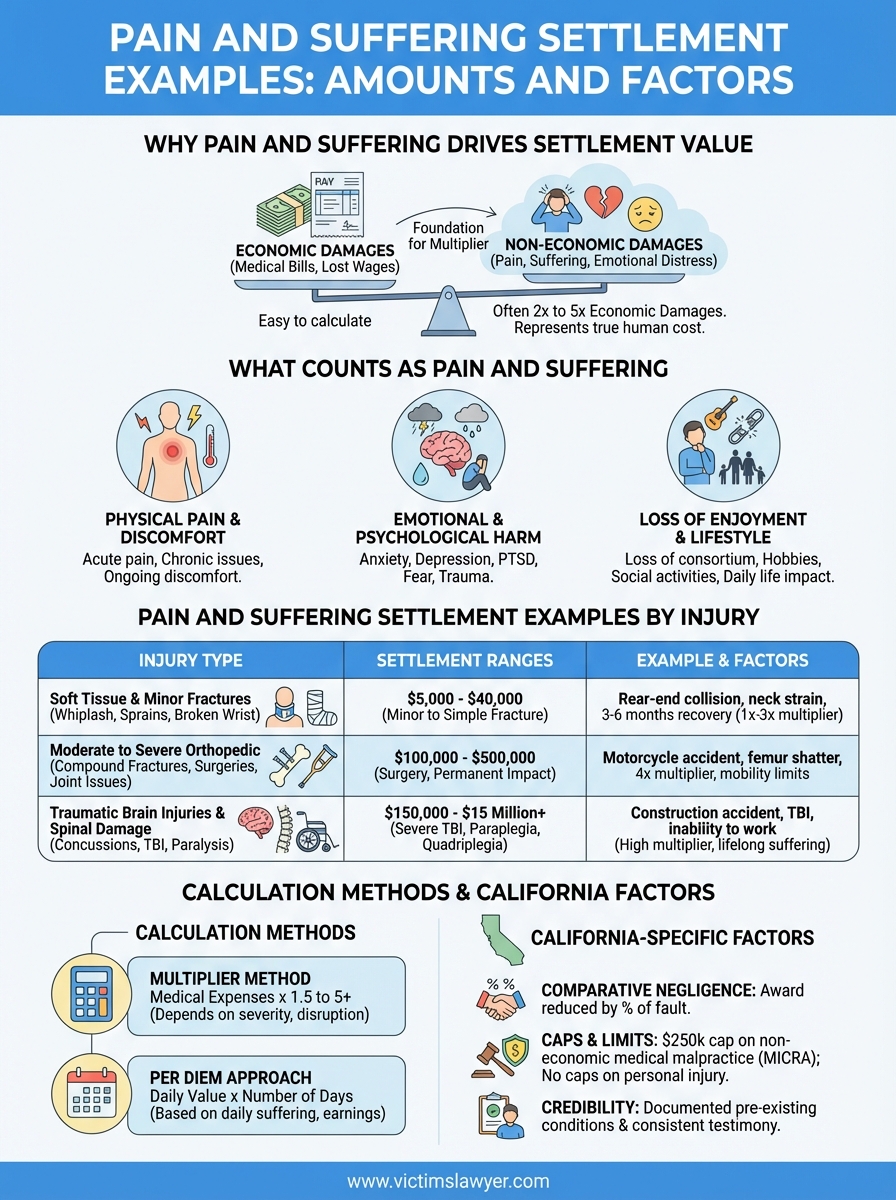
Your medical bills and lost wages are easy to calculate with receipts and pay stubs, but those numbers rarely reflect the full impact of your injury. Pain and suffering compensation makes up the difference between your out-of-pocket losses and the actual harm you’ve endured. In many personal injury settlements, non-economic damages exceed economic damages by two to five times, which means understanding this category directly determines whether you accept a fair offer or leave substantial money on the table.
Economic damages only tell part of your story
You can add up every ambulance ride, surgery, physical therapy session, and missed paycheck to arrive at a precise figure for your economic losses. That total, however, doesn’t account for the chronic pain that wakes you at 3 a.m. or the depression that sets in when you can no longer play with your children the way you used to. These invisible injuries carry no invoice, yet they fundamentally alter your daily existence.
Insurance adjusters start negotiations by focusing solely on your documented expenses because those figures minimize their payout. Pain and suffering settlement examples demonstrate that successful claimants push beyond this narrow view by presenting evidence of how the injury disrupted relationships, career ambitions, and basic quality of life. Your economic damages serve as the foundation, but your non-economic damages capture the true human cost.
Insurers know juries award substantial pain and suffering
When your case has strong liability and serious injuries, insurance companies calculate settlement offers with one eye on what a jury might award at trial. California juries consistently deliver verdicts where pain and suffering comprises the majority of the total award, particularly in cases involving permanent disability or disfigurement. Defense attorneys understand that sympathetic plaintiffs with clear negligence claims can walk away with verdicts that dwarf the initial settlement proposals.
Insurance carriers would rather negotiate a reasonable settlement than risk a jury verdict that includes substantial pain and suffering damages plus their own litigation costs.
This reality creates leverage in your negotiations. The adjuster isn’t doing you a favor by including pain and suffering in their offer; they’re protecting their employer from the financial exposure of going to trial. Your attorney’s reputation for taking cases to verdict and winning directly influences how seriously the insurance company treats your demand for full non-economic compensation.
Your injury severity multiplies total compensation
Most personal injury settlements follow a pattern where your pain and suffering amount correlates with your medical treatment intensity. A soft tissue injury with six weeks of physical therapy might justify one to three times your medical expenses, while a traumatic brain injury requiring years of care can command five times or more. This multiplier approach means that as your documented economic damages increase, your potential pain and suffering recovery grows proportionally.
Severity matters beyond just the math. Catastrophic injuries that permanently alter your capabilities carry dramatically higher pain and suffering values because the impact extends across your entire remaining lifespan. A 30-year-old who loses the use of their dominant hand faces five decades of daily frustration, accommodation, and limitation. Insurers and juries alike recognize that no amount of money truly compensates for that loss, but they assign higher values to reflect the permanence and scope of the damage.
Your injury’s visibility also affects settlement value. Scarring, limps, and other observable conditions make your suffering tangible to adjusters and juries in ways that internal injuries sometimes don’t. Documentation through photographs, video, and testimony from family members bridges this gap by showing rather than simply telling how your injury manifests in real life.
What counts as pain and suffering damages
California law divides your injury compensation into two buckets: economic losses like medical bills, and non-economic losses that address how the injury affects your daily life. Pain and suffering falls into this second category, covering both the physical sensations you endure and the emotional toll that comes with being injured. Understanding exactly what fits under this umbrella helps you identify every aspect of your claim that deserves compensation, not just the obvious physical hurt.
Physical pain and discomfort
Your body’s pain signals represent the most straightforward component of these damages. Acute pain from the initial injury, surgical procedures, physical therapy sessions, and ongoing chronic discomfort all qualify for compensation. This includes the immediate agony of a broken bone, the persistent ache of soft tissue damage, and the sharp jolts that shoot through your body when you move the wrong way months after the accident.
The duration and intensity matter significantly when calculating value. Temporary pain that resolves after a few weeks carries less weight than permanent nerve damage that will plague you for life. Insurance adjusters and juries consider whether your pain requires ongoing medication, limits your mobility, or disrupts your sleep patterns. Each of these factors increases the settlement amount because they demonstrate measurable interference with your normal functioning.
Emotional and psychological harm
Injuries don’t just hurt your body; they damage your mental health in ways that deserve separate recognition. Anxiety, depression, post-traumatic stress, and fear related to your accident all count as compensable pain and suffering. You might develop a phobia of driving after a car crash, experience panic attacks when visiting hospitals, or struggle with depression because you can no longer work in your chosen profession.
Mental anguish carries the same legal weight as physical pain, particularly when you can document treatment with a therapist or psychiatrist.
These psychological impacts often persist longer than your physical injuries. Your broken arm might heal in eight weeks, but the emotional scars from trauma can affect your relationships and daily confidence for years. When reviewing pain and suffering settlement examples, you’ll notice higher awards for claimants who demonstrate this dual impact through medical records, therapy notes, and testimony from mental health professionals.
Loss of enjoyment and lifestyle changes
Beyond pure pain, you deserve compensation when your injury strips away activities that made your life meaningful. Loss of consortium addresses how injuries damage your relationship with your spouse, while loss of enjoyment of life covers hobbies, sports, and social activities you can no longer pursue. If you were an avid runner who can no longer jog, a guitarist who lost finger function, or a parent who can’t lift your children, these losses have real monetary value in your settlement.
Pain and suffering settlement examples by injury
Real settlement amounts vary dramatically based on your injury type, treatment duration, and permanent effects. While every case carries unique circumstances, reviewing actual settlement ranges across injury categories gives you a realistic baseline for negotiations. The following pain and suffering settlement examples reflect California cases handled by personal injury attorneys, showing both the economic damages awarded and the multiplier applied for non-economic compensation.

Soft tissue injuries and minor fractures
Whiplash, sprains, and strains typically settle between $5,000 and $25,000 when your symptoms resolve within three to six months. A rear-end collision causing neck strain with $3,500 in medical bills might yield $10,500 total, with $7,000 representing pain and suffering (a 2x multiplier). Simple fractures like a broken wrist requiring casting but no surgery generally command $15,000 to $40,000, depending on whether you needed physical therapy and how long you remained off work.
Minor injuries with complete recovery see pain and suffering awards of one to three times your medical expenses, while lingering symptoms push that multiplier higher.
Your settlement increases substantially when soft tissue damage creates chronic issues. A disc herniation from a car accident requiring ongoing chiropractic care can settle for $75,000 to $150,000, with non-economic damages comprising 60 to 70 percent of the total award. Documentation showing that your injury prevents specific work tasks or recreational activities justifies these higher amounts.
Moderate to severe orthopedic injuries
Compound fractures, multiple broken bones, or injuries requiring surgical intervention typically settle between $100,000 and $500,000. A shattered femur from a motorcycle accident with $60,000 in medical costs might resolve for $240,000 total, applying a 4x multiplier that reflects your surgical pain, rehabilitation challenges, and permanent mobility limitations. Joint replacements, torn ligaments requiring reconstruction, and crush injuries that leave visible scarring all fall into this category.
Permanent disabilities like chronic pain syndrome or limited range of motion dramatically increase awards. Cases involving hardware implants that remain in your body or multiple surgeries over several years command higher multipliers because they demonstrate ongoing suffering rather than a single traumatic event followed by healing.
Traumatic brain injuries and spinal damage
Concussions with lasting cognitive effects settle from $150,000 to $1 million depending on severity and impact on your earning capacity. Moderate traumatic brain injuries requiring rehabilitation and causing permanent memory or processing deficits regularly exceed $1 million, with pain and suffering representing the bulk of the award. A construction accident resulting in TBI with $200,000 in medical costs might settle for $1.2 million when you demonstrate inability to return to skilled work.
Spinal cord injuries producing partial or complete paralysis routinely generate multi-million dollar settlements. Paraplegia cases settle for $3 million to $8 million, while quadriplegia claims reach $8 million to $15 million or more. These catastrophic injuries justify the highest multipliers because your suffering continues every single day for the rest of your life.
How lawyers and insurers calculate pain and suffering
No standardized formula exists in California law for converting your suffering into dollars, which creates room for negotiation and strategy. Insurance companies and personal injury attorneys use several calculation methods to arrive at their initial positions, though neither side is bound by any single approach. Understanding these frameworks helps you recognize whether an offer reflects genuine evaluation of your claim or simply represents a lowball starting point designed to test your resolve.

The multiplier method
Most adjusters and attorneys start with your total medical expenses and multiply that figure by a number between 1.5 and 5 depending on injury severity. A $20,000 medical bill with moderate injuries might justify a 3x multiplier, producing $60,000 in pain and suffering damages for a total settlement of $80,000. Catastrophic injuries that permanently disable you can push the multiplier to 5 or higher, while minor soft tissue injuries with full recovery rarely exceed 2.
The multiplier method dominates early settlement negotiations because it provides a quick calculation both sides can reference, even when they disagree on which multiplier applies.
Your attorney increases the multiplier by documenting how your injury disrupted your daily life beyond medical treatment. Photographs showing your struggle with basic tasks, testimony from family members about personality changes, and expert reports predicting future complications all push the number higher. Insurance companies lower the multiplier when your medical treatment seems excessive for the diagnosed injury or when gaps in your treatment suggest you weren’t actually suffering as severely as claimed.
The per diem approach
Instead of multiplying medical costs, this method assigns a daily dollar value to your suffering and multiplies it by the number of days you endured pain. You might argue your injury caused $200 per day in suffering over 180 days, yielding $36,000 in non-economic damages. This approach works well for injuries with clear recovery timelines where you can demonstrate specific start and end dates for your pain period.
Attorneys often base the daily rate on your actual daily earnings or a similar concrete figure to give the calculation credibility. Per diem calculations prove particularly effective when pain and suffering settlement examples from similar cases seem inadequate because your medical bills were relatively low despite genuine suffering. A herniated disc treated conservatively with physical therapy rather than surgery might not generate huge medical expenses, but the daily pain over eight months deserves substantial compensation.
Settlement software and manual evaluation
Insurance companies increasingly rely on proprietary software programs like Colossus that evaluate thousands of data points from your claim to generate a settlement range. These systems analyze your injury type, treatment duration, geographic location, and demographic factors to predict jury verdict amounts. The software provides adjusters with target settlement ranges they’re authorized to offer without supervisor approval, though experienced attorneys know how to identify and challenge inputs that undervalue your claim.
What affects pain and suffering amounts in California
California’s legal framework creates specific variables that influence how much you’ll recover for non-economic damages. State laws governing negligence calculations, damage caps, and jury instructions directly impact your settlement negotiations, while practical factors like your attorney’s reputation and the venue where you file your case introduce additional variables. Understanding these California-specific elements helps you set realistic expectations and avoid accepting offers that fail to account for how local rules work in your favor.

California’s comparative negligence rule
Your settlement drops proportionally when you bear partial responsibility for the accident. California follows pure comparative negligence, meaning you can recover damages even if you were 99 percent at fault, but your award decreases by your percentage of blame. If your total damages including pain and suffering equal $100,000 and you were 30 percent responsible, you’ll receive $70,000.
Insurance adjusters aggressively argue your comparative fault to reduce their payout, often claiming you contributed to the accident even when liability seems clear.
This rule creates significant leverage points during negotiations. Defense attorneys scrutinize your actions before and during the accident to identify any behavior that suggests shared responsibility. You were texting while walking across a crosswalk? They’ll argue you contributed. You weren’t wearing a seatbelt? They’ll claim your injuries would have been less severe. Your attorney counters these arguments by demonstrating that the defendant’s negligence was the primary and substantial cause of your harm, minimizing any minor contributory factors.
Medical malpractice caps and other limitations
California imposes a $250,000 cap on non-economic damages in medical malpractice cases under the Medical Injury Compensation Reform Act (MICRA), though this limit may increase with legislation. This ceiling doesn’t apply to car accidents, slip and falls, or other personal injury claims, where no statutory limit exists on pain and suffering awards. Product liability cases similarly face no caps, allowing catastrophic injury victims to pursue full compensation regardless of amount.
Your insurance policy limits also create practical ceilings. When the at-fault party carries only $15,000 in liability coverage, you can’t extract $100,000 from them personally in most situations. Underinsured motorist coverage on your own policy fills this gap by providing additional compensation when pain and suffering settlement examples suggest your claim exceeds the defendant’s resources.
Your credibility and pre-existing conditions
Juries and adjusters discount claims when your testimony contradicts medical records or surveillance footage. Documented pre-existing conditions reduce your award because insurers argue they can’t compensate you for suffering that existed before the accident. A degenerative disc condition that flared up after a rear-end collision receives less pain and suffering compensation than a herniated disc in a previously healthy spine.
Your consistency across medical appointments, deposition testimony, and daily activities directly influences settlement value. Claiming total disability while your social media shows you playing basketball destroys credibility and tanks your potential recovery.
How to document and prove pain and suffering
Insurance adjusters won’t take your word alone when you claim the accident ruined your sleep, strained your marriage, or forced you to abandon hobbies you loved. You need tangible evidence that transforms subjective suffering into objective proof a jury or insurance company can evaluate. Strong documentation creates leverage during settlement negotiations because it removes the guesswork about whether your pain is genuine, allowing your attorney to justify higher compensation using pain and suffering settlement examples that match your documented experience.
Keep a daily pain journal
Your written record of symptoms, limitations, and emotional struggles becomes powerful evidence when it spans the entire recovery period. Start documenting within days of your injury and maintain consistent entries describing your pain levels, medication needs, sleep disruptions, and activity restrictions. Note specific instances where pain prevented you from completing normal tasks like grocery shopping, playing with your children, or performing work duties.
A detailed pain journal showing progression from acute agony to chronic discomfort demonstrates the full arc of your suffering in ways medical records alone cannot capture.
Credible journals avoid exaggeration while capturing honest detail. Record both good days and bad days to show the unpredictable nature of your condition rather than claiming constant maximum pain that sounds fabricated. Include emotional impacts like frustration, anxiety, and depression triggered by your physical limitations, because these psychological dimensions add substantial value to non-economic damage claims.
Collect medical documentation and expert testimony
Your treatment records provide the foundation for proving pain severity, but you need more than billing statements. Request complete clinical notes where doctors describe your reported symptoms, observable pain behaviors, and prescribed treatments. Ask your physician to document how your condition affects daily activities and whether permanent limitations will persist after maximum medical improvement.
Expert testimony from treating physicians, therapists, or pain management specialists adds credibility when they explain your prognosis and ongoing suffering. These professionals can quantify functional impairment using standardized scales and testify about how your specific injury type typically affects quality of life long-term.
Document lifestyle impact through photos and witness statements
Visual evidence makes abstract suffering concrete for adjusters and juries. Photograph visible injuries during healing stages, assistive devices you require, modifications to your home, and activities you can no longer perform safely. Video yourself attempting and struggling with tasks that were once routine to demonstrate real-world limitations.
Statements from family members, friends, and coworkers who observe your daily struggles carry significant weight. Your spouse describing personality changes, reduced intimacy, and your visible pain provides third-party corroboration that counters insurance company skepticism about self-reported symptoms.
Next steps
Reviewing pain and suffering settlement examples gives you a baseline for understanding your claim’s potential value, but no two cases are identical. Your actual settlement depends on specific factors like injury severity, treatment duration, liability strength, and how well you document your suffering. Insurance adjusters will use every tactic to minimize your non-economic damages, from questioning credibility to arguing comparative fault.
You need an attorney who knows how to present your claim in ways that command maximum compensation. At Steven M. Sweat, Personal Injury Lawyers, APC, we’ve secured hundreds of millions in verdicts and settlements by building comprehensive documentation packages that force insurers to take our clients seriously. We handle cases on contingency, meaning you pay nothing unless we recover money for you.
Contact our Los Angeles personal injury team for a free consultation available 24/7. We’ll review your injury details, explain what your case might be worth, and outline the steps needed to maximize your recovery. Call toll free 24/7 at 866-966-5240