- Free Consultation: 866-966-5240 Tap Here To Call Us













How Long Do Settlement Negotiations Take? Timeline & Delays


You’ve been injured, you’ve filed a claim, and now you’re stuck waiting. The question burning in your mind is simple: how long do settlement negotiations take? For most personal injury cases in California, the answer ranges from a few weeks to several months, but some disputes drag on for a year or more.
At Steven M. Sweat, Personal Injury Lawyers, APC, we’ve guided thousands of injured Californians through this process over the past 25+ years. We understand that every day without a resolution means mounting medical bills, lost wages, and emotional strain. The uncertainty can feel unbearable when your financial future hangs in the balance.
The truth is, settlement timelines depend on several factors within, and sometimes outside, your control. Insurance company tactics, the severity of your injuries, disputed liability, and even the quality of your documentation all play a role. This article breaks down the typical phases of negotiation, explains what causes delays, and gives you a realistic picture of when you can expect money in hand once an agreement is reached.
Why settlement negotiations take time
Settlement negotiations rarely move as quickly as you’d like because insurance companies deliberately slow the process to protect their bottom line. Their adjusters handle hundreds of claims simultaneously and have zero urgency to settle your case when they can hold onto their money. Additionally, your injury claim requires complete medical documentation before any meaningful negotiation can begin, which means you cannot rush toward settlement while you’re still receiving treatment or before doctors fully understand the extent of your injuries.
Medical treatment must finish first
You cannot finalize settlement negotiations until you reach maximum medical improvement (MMI), the point where doctors determine your condition has stabilized and they understand the full scope of your recovery or permanent limitations. Settling before this milestone means you risk accepting compensation that doesn’t cover future medical expenses, ongoing therapy, or long-term disability accommodations. Your attorney will advise against any early settlement because once you sign a release, you cannot come back for more money if complications arise later.
Some injuries require months or years of treatment before doctors can assess permanent damage. Back injuries, traumatic brain injuries, and nerve damage often take six to twelve months to fully reveal themselves. Insurance companies know this timeline and sometimes pressure victims to settle early, hoping you’ll accept less money before realizing how serious your condition truly is.
Rushing to settle before you finish treatment is one of the most expensive mistakes injury victims make.
Insurance companies need time to investigate
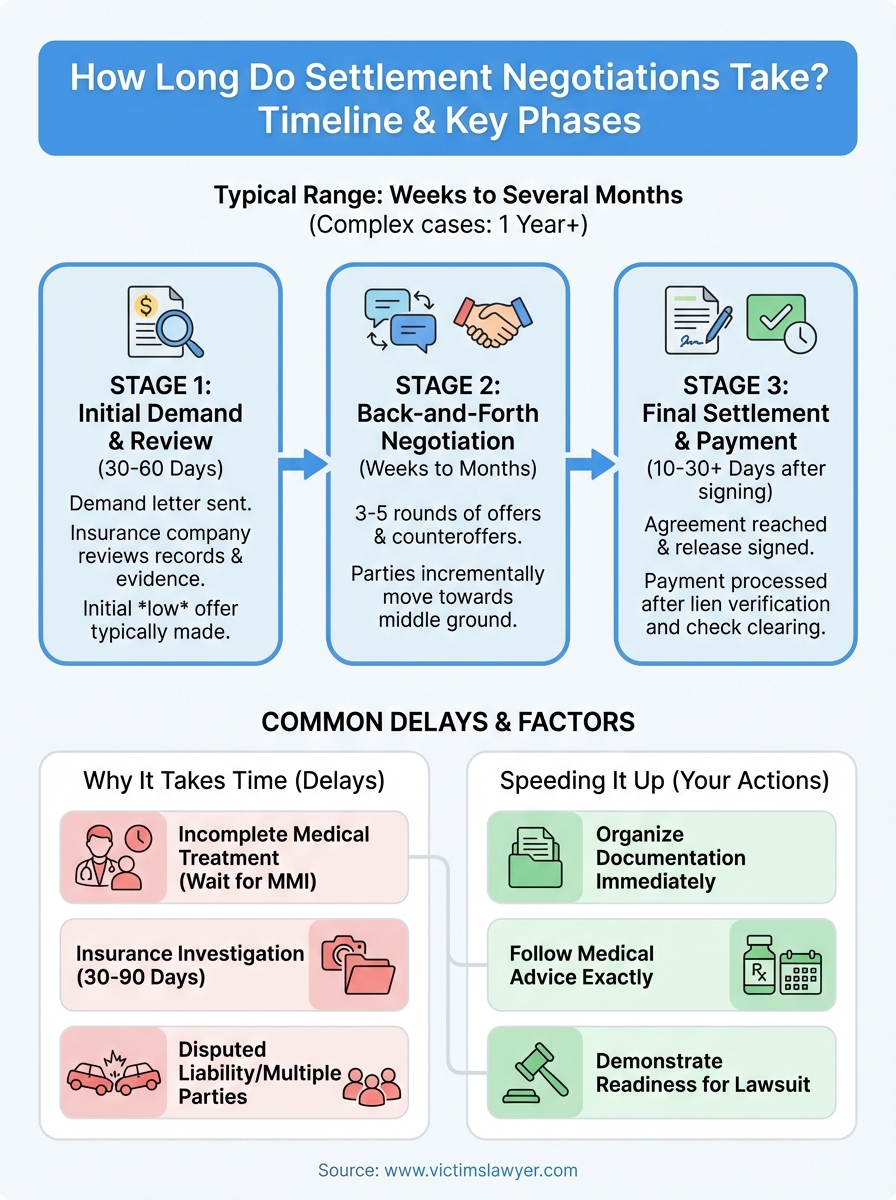
Adjusters must review your medical records, accident reports, witness statements, and all supporting evidence before making any legitimate settlement offer. They will order your complete medical history, contact treating physicians, examine scene photographs, and sometimes hire investigators to verify your claim. This investigation process typically takes 30 to 90 days for straightforward cases, but complex accidents involving disputed liability or severe injuries stretch far longer.
Insurance companies also use this investigation period strategically to look for reasons to deny or minimize your claim. They search for pre-existing conditions, gaps in treatment, or inconsistencies in your story. If liability is unclear or multiple parties share fault, they spend additional weeks coordinating with other insurers to determine who pays what percentage.
Multiple parties complicate the process
When your accident involves more than one defendant or insurance policy, how long do settlement negotiations take multiplies significantly. A truck accident might involve the driver, trucking company, vehicle manufacturer, and cargo loader, each with separate insurance carriers who must coordinate their responses. Each party protects its own interests rather than working together to compensate you fairly.
Government entities add another layer of delay because they follow strict claim procedures with specific deadlines and documentation requirements. Cases involving underinsured motorist coverage require your own insurance company’s participation, creating additional negotiation rounds. Construction site accidents, product liability claims, and medical malpractice cases often involve five or more parties, each conducting separate investigations and making independent settlement decisions that drag the process into many months or beyond a year.
How the settlement negotiation timeline works
Settlement negotiations follow a predictable three-stage process that typically spans two to six months for straightforward injury claims, though complex cases extend well beyond that range. Your attorney initiates the process after you complete treatment and they have gathered all necessary medical records, bills, and evidence documenting your losses. Understanding each phase helps you set realistic expectations and recognize when progress stalls.

Initial demand letter stage
Your lawyer sends a detailed demand letter to the insurance company outlining your injuries, liability facts, medical treatment, lost wages, and the compensation amount you’re seeking. This document serves as your opening position and typically includes copies of medical records, accident reports, photographs, and expert opinions that support your claim. Insurance adjusters usually take 30 to 60 days to review this package and respond with their initial offer.
The first offer from the insurance company almost always comes in far below your demand because adjusters start negotiations with lowball figures they know you’ll reject. They test whether you have strong legal representation and genuine willingness to fight for fair compensation. Your attorney expects this tactic and has already calculated the realistic settlement range based on similar case outcomes.
Back-and-forth negotiation phase
After the initial offer, your lawyer counters with a reduced demand that remains above what they believe the case is worth, and the adjuster responds with a slightly higher offer. This back-and-forth exchange typically involves three to five rounds of offers and counteroffers spanning several weeks or months, with each side moving incrementally toward a middle ground. Strategic negotiators know when to hold firm and when to make concessions that push the other side closer to settlement.
Your attorney’s experience with similar cases and knowledge of jury verdict ranges gives them leverage the insurance company cannot ignore.
Final settlement and release
Once both sides reach an acceptable number, the insurance company drafts a settlement agreement and release document that details the payment amount and terms. You sign this release acknowledging that you accept the settlement as full compensation and cannot pursue additional claims for this accident. Most insurance companies issue payment within 10 to 30 days after receiving your signed release, though understanding how long do settlement negotiations take from start to finish helps you plan financially for this entire process.
Common delays that slow down negotiations
Even straightforward injury claims hit roadblocks that extend how long do settlement negotiations take well beyond the average timeline. Insurance companies exploit every opportunity to delay payments while they investigate your claim, and sometimes delays stem from circumstances beyond anyone’s control. Recognizing these obstacles helps you understand why your case isn’t moving as quickly as you expected and what your attorney must address to break through the stalemate.

Disputed liability or shared fault
Negotiations stall when the insurance company claims you share responsibility for the accident or disputes who caused it entirely. Adjusters spend weeks collecting additional evidence, interviewing witnesses, and consulting accident reconstruction experts to build a case that shifts blame onto you. California’s comparative negligence rules mean any fault assigned to you reduces your compensation dollar for dollar, so insurance companies aggressively pursue this defense strategy.
Cases involving intersections, rear-end collisions with sudden stops, or pedestrian accidents frequently face liability disputes that add two to six months to the negotiation process. Your attorney must counter with their own investigation and expert testimony to establish the other party’s negligence clearly.
Missing or incomplete documentation
Your claim cannot move forward when medical records, billing statements, or employment verification remain incomplete or delayed. Hospitals and doctors’ offices often take 30 to 90 days to fulfill records requests, and missing documentation gives insurance adjusters an excuse to pause negotiations entirely. Gaps in your treatment history raise red flags that adjusters exploit to question whether the accident truly caused your injuries.
Insurance companies will not make serious settlement offers until they see complete documentation of every medical expense and wage loss you’re claiming.
Insurance bad faith tactics
Some adjusters deliberately drag out negotiations by making unreasonably low offers, requesting duplicate documentation, or failing to respond to your attorney’s communications. These bad faith tactics aim to frustrate you into accepting less money than your claim deserves. Adjusters sometimes claim they need supervisor approval that never comes, or they reassign your file to new handlers who restart the investigation from scratch, adding months to your case timeline.
How to move settlement talks forward faster
You cannot control insurance company tactics, but you can take specific actions that prevent unnecessary delays and push negotiations toward resolution. Your level of preparation and responsiveness directly impacts how long do settlement negotiations take in your case. Attorneys who represent well-prepared clients with complete documentation and realistic expectations often close cases months faster than those dealing with disorganized claimants who slow the process.
Organize your documentation immediately
Start collecting every piece of evidence from the moment your accident happens rather than waiting for your attorney to request it later. Keep a detailed file containing medical bills, prescription receipts, pay stubs showing lost wages, photographs of your injuries and property damage, and contact information for all witnesses. Digital copies stored in cloud storage give your lawyer instant access and prevent delays caused by missing paperwork or records requests that take weeks to fulfill.
Maintain a written timeline documenting each doctor visit, symptom change, and how your injuries affect daily activities. Insurance adjusters look for gaps or inconsistencies in treatment that they exploit during negotiations, so comprehensive records eliminate their ability to question your claim’s validity.
Follow all medical advice exactly
Missing appointments or ignoring your doctor’s treatment recommendations gives insurance companies ammunition to argue your injuries are not as serious as you claim or that you caused your own delayed recovery. Adjusters will deny compensation for treatment you refused or delays caused by your failure to follow prescribed therapy. Complete every recommended treatment and attend all follow-up visits because your medical records tell the story of your injury, and gaps in care weaken your negotiating position substantially.
Insurance companies will use any excuse to reduce their payment, and inconsistent medical treatment is one of their favorite defenses.
Demonstrate readiness to file a lawsuit
Adjusters settle cases faster when they believe your attorney will take the case to trial rather than accept a lowball offer. Your lawyer signals this readiness by conducting thorough investigations, consulting expert witnesses, and filing a lawsuit when negotiations reach a dead end. The threat of litigation costs and potential jury verdicts often motivates insurance companies to make reasonable settlement offers rather than risk losing far more money in court.
How long it takes to get paid after settlement
After you accept a settlement offer and sign the release, you still face a waiting period of 14 to 45 days before money hits your bank account. Understanding how long do settlement negotiations take is only half the picture because the post-settlement administrative process adds several weeks to your timeline. Insurance companies, attorneys, and medical providers all complete specific tasks before you receive your portion of the settlement funds.
Processing the settlement paperwork
The insurance company typically issues your settlement check within 10 to 30 days after receiving your signed release, though some carriers push this to 45 days or longer. Your attorney receives this check in their trust account rather than sending it directly to you because they must first resolve outstanding liens and pay agreed-upon legal fees. Medical providers who treated you on a lien basis have legal rights to their portion of the settlement, and your attorney verifies every lien amount before distributing funds.
This verification process takes one to two weeks because medical billing departments often inflate their final lien amounts, and your lawyer negotiates these down to save you money. Workers’ compensation carriers, health insurance companies, and Medicare or Medi-Cal also file liens that require careful calculation to avoid overpayment.
Receiving your final payment
Your attorney deposits the insurance company’s check into their trust account, where it must clear for five to seven business days before they can distribute funds. California law requires attorneys to hold settlement proceeds in these protected accounts and only release money after the check fully clears and all liens are satisfied. Once the check clears and liens are paid, your lawyer deducts their contingency fee and case costs, then sends you the remaining balance via check, wire transfer, or direct deposit.
Expect to wait a total of three to seven weeks from the day you sign the release until money arrives in your account.
Next steps if you are stuck waiting
Understanding how long do settlement negotiations take gives you realistic expectations, but waiting months for compensation while bills pile up creates real financial hardship. Your attorney should provide regular updates every two to three weeks explaining exactly where negotiations stand and what obstacles remain. If weeks pass without communication or progress, you have every right to demand answers and push for more aggressive action.
When negotiations stall completely, your lawyer can file a lawsuit to force the insurance company’s hand. The threat of trial costs and jury verdicts often motivates adjusters who ignored reasonable settlement demands. Contact our team at Steven M. Sweat, Personal Injury Lawyers, APC for a free consultation if your case sits dormant or you question whether your current attorney is fighting hard enough for fair compensation. We have secured hundreds of millions of dollars for California injury victims over 25+ years by refusing to accept insurance company delays and lowball tactics.