- Free Consultation: 866-966-5240 Tap Here To Call Us













FMCSA Hours Of Service Rules Explained: 11, 14, 70 Hours


Article Summary: Federal Motor Carrier Safety Administration (FMCSA) Hours of Service rules are critical safety regulations designed to curb driver fatigue and prevent catastrophic trucking accidents involving commercial motor vehicles. These standards establish strict limits, including an 11-hour driving cap within a 14-hour on-duty window, a mandatory 30-minute break after eight hours of driving, and weekly caps of 60 or 70 hours depending on carrier operations. While exceptions exist for short-haul trips, agricultural needs, and adverse weather conditions, strict adherence is mandatory for most vehicles operating in interstate commerce. For victims of truck accidents, proving a violation of these rules through Electronic Logging Device (ELD) data serves as powerful evidence in personal injury litigation against negligent carriers and drivers who prioritize delivery deadlines over public safety. Compliance requires proactive route planning and accurate log management to ensure drivers remain within legal rest requirements. Ultimately, these regulations create an enforceable boundary between manageable fatigue and dangerous impairment, protecting all motorists sharing the road with heavy commercial vehicles. Understanding these nuances is essential for drivers maintaining their credentials and for legal professionals seeking accountability and compensation after a devastating collision.
Federal regulations cap how long commercial truck drivers can stay behind the wheel before they must rest, and for good reason. Fatigued driving is one of the leading contributors to catastrophic trucking accidents across the United States. The FMCSA Hours of Service rules establish specific limits on driving time, mandatory break periods, and weekly on-duty caps that every carrier and driver must follow. When these rules are ignored, the consequences often fall on other motorists, families in passenger vehicles who never saw the crash coming.
At Steven M. Sweat, Personal Injury Lawyers, APC, we’ve spent over 25 years representing people in Los Angeles and throughout California who’ve been seriously hurt in collisions with commercial trucks. A significant number of those cases involve drivers or trucking companies that cut corners on rest requirements to meet delivery deadlines. Proving an HOS violation can be a powerful piece of evidence in a personal injury or wrongful death claim, and understanding these rules is the first step toward holding negligent parties accountable.
This article breaks down the core FMCSA Hours of Service regulations, the 11-hour driving limit, the 14-hour on-duty window, the required 30-minute break, and the 60/70-hour weekly caps. Whether you’re a truck driver checking your own compliance or someone injured in a truck accident trying to understand what went wrong, this guide will give you a clear and thorough explanation of how these rules work.
Why FMCSA hours of service rules matter
The Federal Motor Carrier Safety Administration created these regulations after decades of evidence showing that fatigued truck drivers cause serious, often fatal crashes on roads across the country. Commercial trucks can weigh up to 80,000 pounds when fully loaded, and when a driver falls asleep or loses focus after too many hours on the road, the results are rarely minor. The fmcsa hours of service rules exist to set a hard, enforceable boundary between manageable fatigue and the kind of dangerous impairment that turns an 18-wheeler into a hazard for every other person sharing the highway. Without these rules, carriers could demand that drivers stay on the road indefinitely to meet deadlines, and some companies would do exactly that.
The link between driver fatigue and serious crashes
Driver fatigue is not simply a matter of feeling drowsy. Research from federal transportation safety agencies shows that fatigued drivers experience significantly slower reaction times, reduced situational awareness, and impaired decision-making at levels that can rival those caused by alcohol. Studies have found that a driver who has been awake for 18 consecutive hours performs at a level comparable to someone with a blood alcohol concentration of 0.08 percent, which is the legal threshold for intoxication in most states. At that level of impairment, controlling a vehicle weighing tens of thousands of pounds before hitting another car, a pedestrian, or a highway barrier becomes far more difficult than most people realize.
Trucking companies face relentless pressure to deliver freight faster and at lower cost, which often means dispatchers and fleet managers push drivers beyond what is safe. Unrealistic delivery schedules and financial penalties for late loads create an environment where drivers feel they cannot stop, even when their bodies are signaling that they must. The hours of service rules exist to counter that pressure directly, giving drivers an enforceable right to rest and placing legal responsibility on carriers when they build routes or schedules that simply cannot be completed within the mandated time limits.
When a trucking company ignores federal rest requirements, every driver and passenger sharing the road with that truck faces an elevated risk of catastrophic injury.
What HOS violations mean for accident victims
If you or someone in your family was hurt in a collision with a commercial truck, HOS violations are among the first pieces of evidence a personal injury attorney will look for when building your case. Federal law now requires carriers to use electronic logging devices (ELDs) that automatically record a driver’s hours behind the wheel. Those records can show clearly whether a driver was operating beyond their legal limit at the moment of the crash, and that data can become central to establishing liability against both the driver and the trucking company that employed them.
Beyond individual crashes, repeated violations often reveal much deeper failures within a carrier’s safety culture. When a company consistently allows or pressures its drivers to exceed federally mandated rest limits, that pattern can support claims for punitive damages on top of compensation for medical bills, lost wages, and long-term disability costs. Securing that evidence quickly matters, because ELD records and dispatch logs can be lost or overwritten if a legal hold is not placed on them soon after a crash. Knowing that these records exist, and knowing what they can prove, gives injured victims and their attorneys a powerful foundation for pursuing full and fair compensation.
Who must follow these rules and when they apply
Not every driver on the road is subject to the fmcsa hours of service rules, but the scope is broader than many people assume. The regulations apply to anyone operating a commercial motor vehicle (CMV) in interstate commerce, meaning the vehicle crosses state lines or carries goods that will eventually cross state lines at some point in the supply chain. That definition covers a wide range of drivers beyond the obvious long-haul truckers pulling coast-to-coast routes.
Which vehicles and drivers are covered
The key threshold comes down to the vehicle’s weight and what it carries. Federal rules cover drivers operating any vehicle with a gross vehicle weight rating (GVWR) or gross combination weight rating (GCWR) of 10,001 pounds or more. Beyond weight, the rules also apply to vehicles transporting hazardous materials in quantities requiring placards, or any vehicle designed or used to carry eight or more passengers for compensation or sixteen or more passengers without compensation.

| Trigger | Threshold |
|---|---|
| Vehicle weight (GVWR/GCWR) | 10,001 lbs or more |
| Passengers for hire | 8 or more |
| Passengers not for hire | 16 or more |
| Hazardous materials | Any quantity requiring placards |
Private carriers, not just large commercial freight companies, fall under these requirements if their vehicles meet the qualifying criteria. Owner-operators who drive their own trucks under their own authority carry the same legal obligations as drivers employed directly by major fleets, and they cannot sidestep the rules simply because no employer is watching.
When the rules kick in and when they don’t
The regulations activate the moment a driver begins operating a qualifying vehicle in interstate commerce. Intrastate commerce, meaning transport that stays entirely within one state, falls under that individual state’s own rules, which may differ from federal standards. California, for example, maintains its own HOS regulations for drivers operating solely within state borders, and those state rules do not always match federal requirements exactly.
If a driver’s route crosses even one state line, federal HOS rules govern every hour of that trip, regardless of where the driver physically stops.
Certain operations are partially or fully exempt from the standard rules, including agricultural transport during planting and harvest seasons, short-haul drivers who return to their home terminal within a defined radius each shift, and drivers responding to active emergency declarations. Each exemption carries strict qualifying conditions, and a driver cannot claim one without genuinely meeting every listed requirement.
The core HOS rules explained with clear examples
The fmcsa hours of service rules organize a driver’s workday around four specific limits that work together as a system. Understanding each rule on its own is fairly straightforward, but the real compliance challenge comes from how these rules interact with each other across a full shift.
The 11-hour driving limit and 14-hour on-duty window
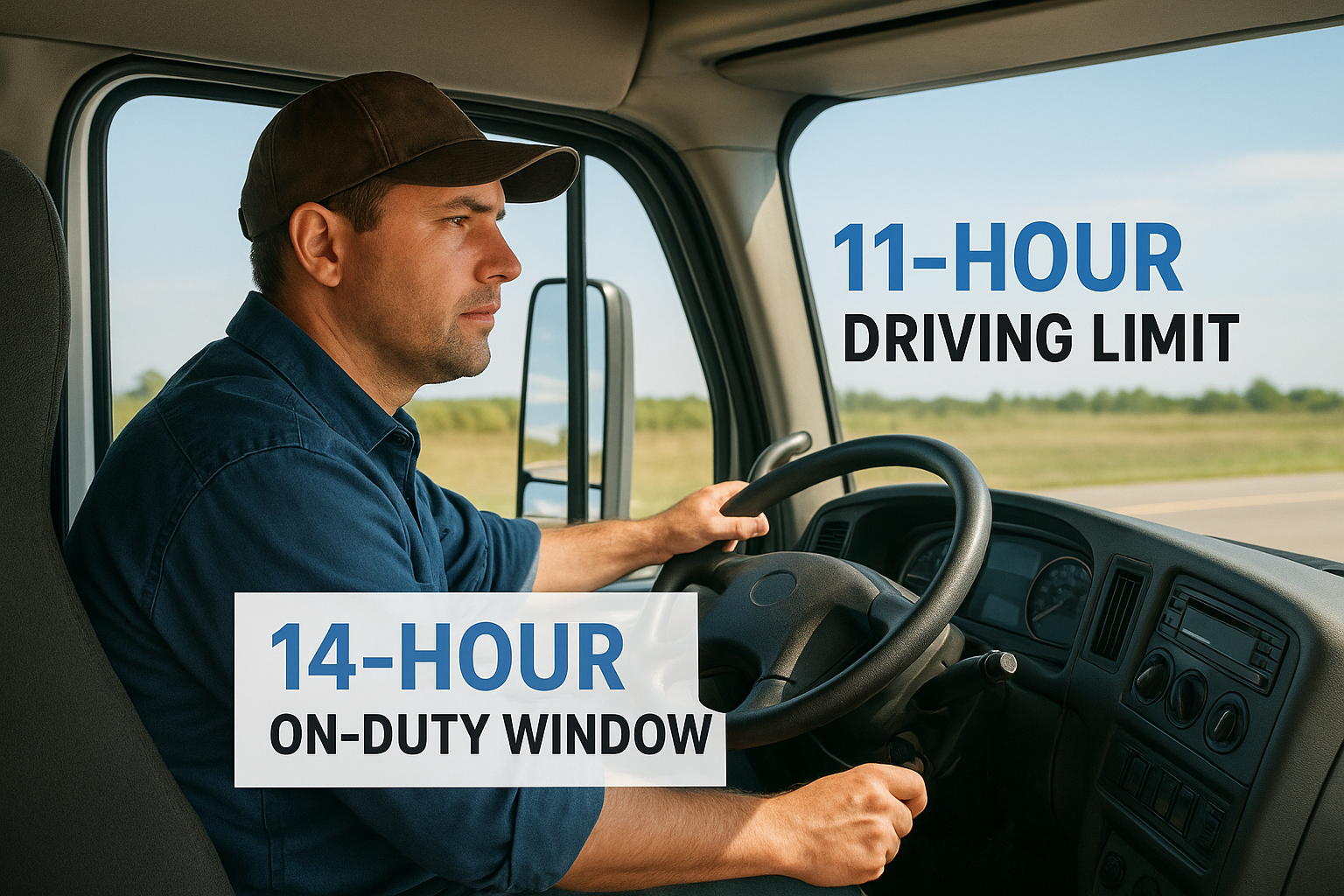
A property-carrying driver may drive a maximum of 11 hours following 10 consecutive hours off duty. That 11-hour driving allowance sits inside a larger 14-hour on-duty window that starts the moment a driver goes on duty, regardless of whether they are actually behind the wheel. Time spent loading freight, completing paperwork, or waiting at a shipper’s dock all counts against the 14-hour clock.
Consider this example: if your driver clocks in at 6:00 a.m., the 14-hour window closes at 8:00 p.m. Even if two hours are spent on non-driving tasks early in the shift, those two hours still reduce the total time available to complete the run before the window expires.
Once the 14-hour window closes, a driver cannot legally drive again until they complete 10 consecutive hours off duty, even if they still have unused driving hours remaining.
The 30-minute break requirement
Drivers must take a 30-minute break before driving beyond the 8-hour mark from the start of their shift. That break must be an uninterrupted period of off-duty or sleeper berth time, which means a quick stop where the driver remains on duty for any reason does not qualify. If you reach the 8-hour mark with no recorded break, you cannot legally continue driving until you complete that full 30 minutes of qualifying rest.
The 60/70-hour weekly limit and the 34-hour restart
Two separate weekly caps apply depending on how many days your carrier operates:
- 70-hour limit over any consecutive 8-day period for carriers operating 7 days a week
- 60-hour limit over any consecutive 7-day period for carriers that do not operate every day
Once you reach your weekly cap, you cannot drive again until enough hours drop off the rolling window. Alternatively, taking an uninterrupted 34-hour restart period resets your weekly on-duty total back to zero, giving you a fresh cycle to begin a new week of runs.
Common exceptions and special situations
The fmcsa hours of service rules do not apply in exactly the same way to every driver on every trip. Several recognized exceptions modify or suspend specific requirements for qualifying operations, but each one comes with conditions that must be met precisely. Claiming an exception you do not actually qualify for exposes both the driver and the carrier to serious regulatory penalties, and it will not protect either party from liability if a crash occurs.
The short-haul exemption
Drivers who operate within a 150 air-mile radius of their home terminal and return to that terminal within 14 hours may qualify for the short-haul exemption. Under this exception, you are not required to use an electronic logging device, and the 30-minute break requirement does not apply to your shift. However, you must still stay within the 11-hour driving limit and cannot exceed the 14-hour on-duty window.
If you leave your home terminal and do not return within 14 hours on even a single day, you lose short-haul eligibility for that entire shift and must comply with the full standard rules.
Short-haul drivers need to track their hours accurately even without an ELD, because inspectors can and do verify compliance through paper logs or other records during roadside checks.
The adverse driving conditions exception
When unexpected weather, road closures, or other hazardous conditions develop after a trip has already started, drivers may extend their driving window by up to 2 hours to reach a safe stopping point. This exception allows up to 13 hours of total driving time and extends the 14-hour window to 16 hours in qualifying situations.
The key word is unexpected. Conditions that existed before you left the terminal do not qualify, and you cannot use this exception to push through foreseeable delays like routine heavy traffic or seasonal weather patterns that are common in your region.
Agricultural and emergency exemptions
Agricultural drivers transporting crops, livestock, or farm supplies during planting and harvest seasons may qualify for relief from certain HOS requirements within a 150 air-mile radius of the source of the commodity. The exemption period and scope vary by state, so you need to verify the specific rules that apply to your state and commodity before relying on this exception.
Emergency declarations issued by federal or state governments can suspend specific HOS requirements for drivers providing direct relief or restoration services. These exemptions are time-limited, geographically defined, and tied to the specific emergency, which means you should confirm active declaration status before altering your compliance approach.
How to stay compliant and avoid violations
Staying on the right side of the fmcsa hours of service rules is not a passive process. Compliance requires active tracking of your time, consistent use of the tools available to you, and a clear understanding of how different limits interact throughout your shift. Errors and oversights accumulate quickly, and a single miscalculation at the start of your day can leave you technically in violation well before your route is finished.
Your best protection against a violation is treating every minute of on-duty time, driving or otherwise, as a resource you cannot afford to waste.
Use your ELD correctly and every shift
Your electronic logging device is your primary compliance tool, but only if you operate it correctly. Many violations result not from deliberate rule-breaking but from improperly logged status changes, such as failing to switch from on-duty to sleeper berth when you stop, or leaving driving mode active while parked. Review your logs at the end of each shift to catch input errors before they become official record. If your device allows manual edits with annotations, use that feature to correct genuine mistakes promptly and accurately.
Carriers share responsibility here as well. If your fleet manager or dispatcher builds a schedule that cannot physically be completed within your available hours, you have a legal and safety basis to refuse that route. Federal regulations place duties on carriers, not just drivers, and no delivery deadline justifies a violation.
Plan your route around your hours, not the other way around
Before you leave the terminal, map your expected driving time against your available 11-hour limit and confirm that your destination falls well within your 14-hour window after accounting for loading, inspections, fuel stops, and your required 30-minute break. Building buffers into your plan gives you room to handle unexpected delays without running out of legal driving time mid-route.
Check your weekly hour total before each new assignment. Drivers who stay close to their 60/70-hour cap without realizing it often get caught short mid-week when they accept routes that assume a full legal reset. If your running total is close to the limit, communicate that clearly to dispatch before you accept the load, not after you are already behind the wheel.
Key takeaways
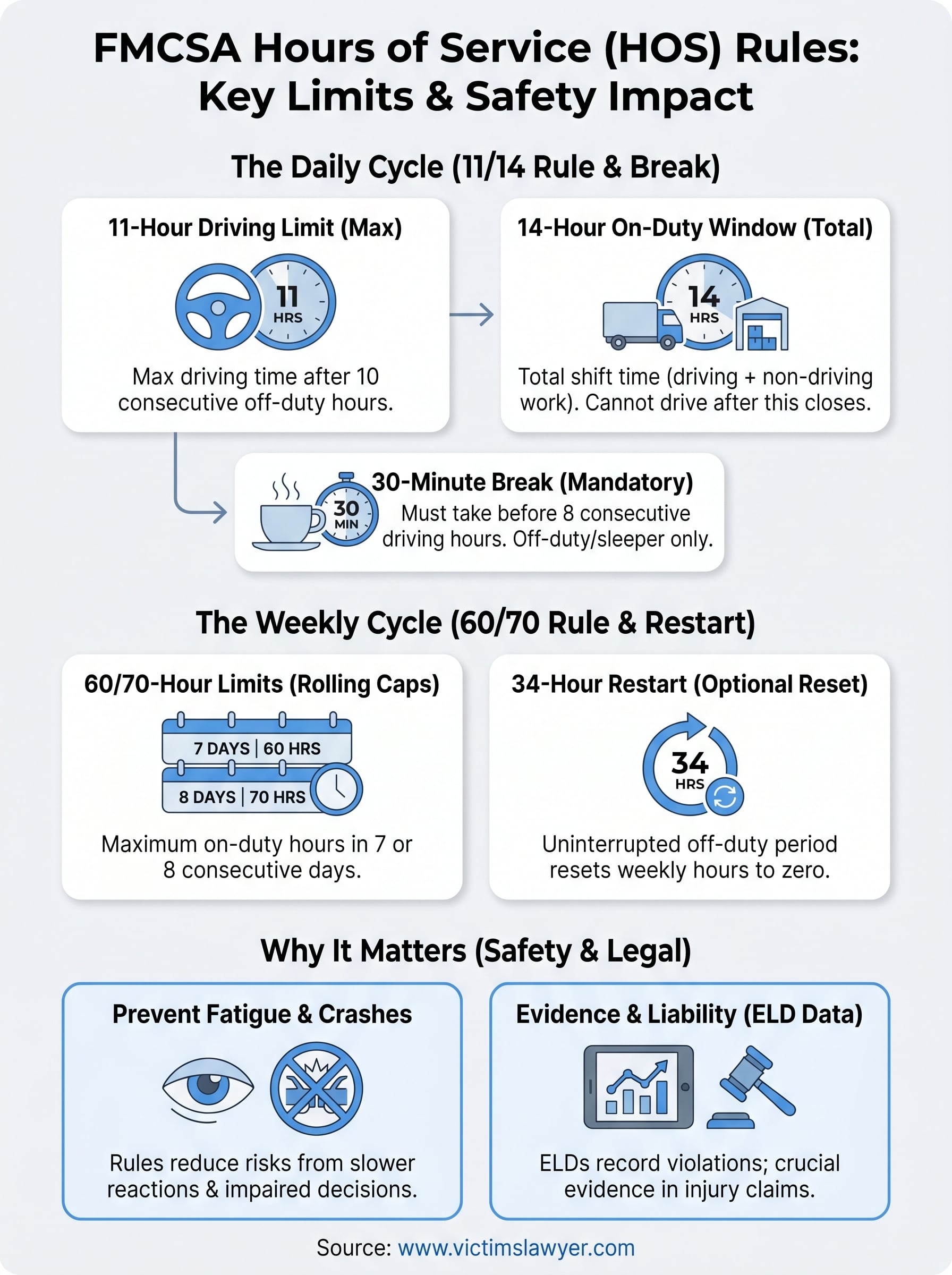
The fmcsa hours of service rules set hard limits on how long commercial truck drivers can operate before they must rest: 11 hours of driving inside a 14-hour on-duty window, a mandatory 30-minute break before crossing the 8-hour mark, and a 60 or 70-hour weekly cap depending on your carrier’s operating schedule. These rules exist because fatigued driving in a vehicle weighing tens of thousands of pounds creates a serious danger for everyone else on the road.
Staying compliant means planning your route around your available hours, using your ELD accurately every shift, and communicating your hour totals to dispatch before accepting new loads. Violations carry regulatory penalties, and when a crash occurs, HOS records become some of the most critical evidence in any personal injury case.
If a truck accident has left you or someone you love seriously injured, contact our legal team today to discuss your options.