- Free Consultation: 866-966-5240 Tap Here To Call Us












California Wrongful Death Statute Of Limitations Explained


Article Summary: California law enforces a strict statute of limitations for wrongful death claims, serving as a hard legal cutoff that permanently bars lawsuits if missed. While the general rule under Code of Civil Procedure Section 335.1 allows for two years from the date of death, various factors can dramatically shorten this window. For instance, medical malpractice claims are governed by complex rules that often reduce the filing period to one year from the discovery of negligence. Furthermore, any claim involving a government agency or employee requires an administrative filing within a mere six months under the Government Claims Act. Because insurance companies and defense counsel monitor these dates closely to secure case dismissals, accurately calculating the deadline based on a certified death certificate is paramount. The two-year clock begins on the date of death, not the date of the original injury, making precise timing essential for eligible heirs like spouses and children. Given these rigid procedural hurdles and the risk of permanent forfeiture of compensation, families must act swiftly to identify responsible parties and file necessary paperwork before their legal remedy expires.
Losing a family member because of someone else’s negligence is devastating, and the last thing on your mind is a legal deadline. But in California, the california wrongful death statute of limitations sets a strict window for filing a lawsuit, and missing it almost always means losing your right to compensation entirely, no matter how strong your case is.
The general rule is two years from the date of death. That sounds straightforward, but it rarely is. Medical malpractice claims, cases involving government entities, and situations where the cause of death wasn’t immediately apparent can all shift the timeline in ways that catch families off guard. Certain exceptions shorten the deadline to as little as six months, while others may extend it beyond the standard two-year period.
At Steven M. Sweat, Personal Injury Lawyers, APC, we’ve spent over 25 years representing families across California in wrongful death cases and have recovered hundreds of millions of dollars in verdicts and settlements. We wrote this guide to give you a clear breakdown of every deadline, exception, and procedural detail you need to know, so you can protect your claim before time runs out.
Why the statute of limitations matters in wrongful death
The statute of limitations is not a technicality that courts occasionally overlook. It is a hard legal cutoff that ends your right to sue, and California courts enforce it without exception in nearly every case. If you file even one day after your deadline expires, the defendant’s attorney will file a motion to dismiss, and the judge will grant it. Your case ends with that motion, regardless of how strong your evidence is or how negligent the defendant was.
Missing the filing deadline is one of the most preventable reasons wrongful death families permanently lose their right to compensation.
What happens when you miss the deadline
When you file a wrongful death lawsuit after the statute of limitations has passed, the court does not evaluate the merits of your claim. The defendant simply raises the expired deadline as an affirmative defense, and the case ends there. You cannot restart the clock, refile under a different theory, or ask the court for an extension because you were unaware of the deadline. California’s Code of Civil Procedure treats the limitation period as absolute once it expires, which is why understanding exactly when your clock starts and stops is critical from the moment you lose your loved one.
Judges do have narrow discretion to toll, or pause, the statute in specific circumstances, but families who wait to consult an attorney often discover those exceptions do not apply to them. Procrastination is the single biggest threat to a valid wrongful death claim, and it costs families their only legal remedy.
Why the defense side watches your deadline closely
Insurance companies and defense attorneys track the california wrongful death statute of limitations on every open claim they handle. Their legal teams monitor filing dates, and they know that if you miss yours, they owe you nothing. Defense adjusters may draw negotiations out, offering small amounts and requesting more documentation, specifically to consume as much of your remaining time as possible. If the deadline passes while you wait for a settlement offer, they can simply withdraw from talks entirely.
You need to treat the filing deadline as a firm date that exists independent of any settlement discussion. Negotiations do not pause the clock, and an insurance company’s willingness to talk does not mean they have waived the statute of limitations as a defense.
The standard two-year deadline and when it starts
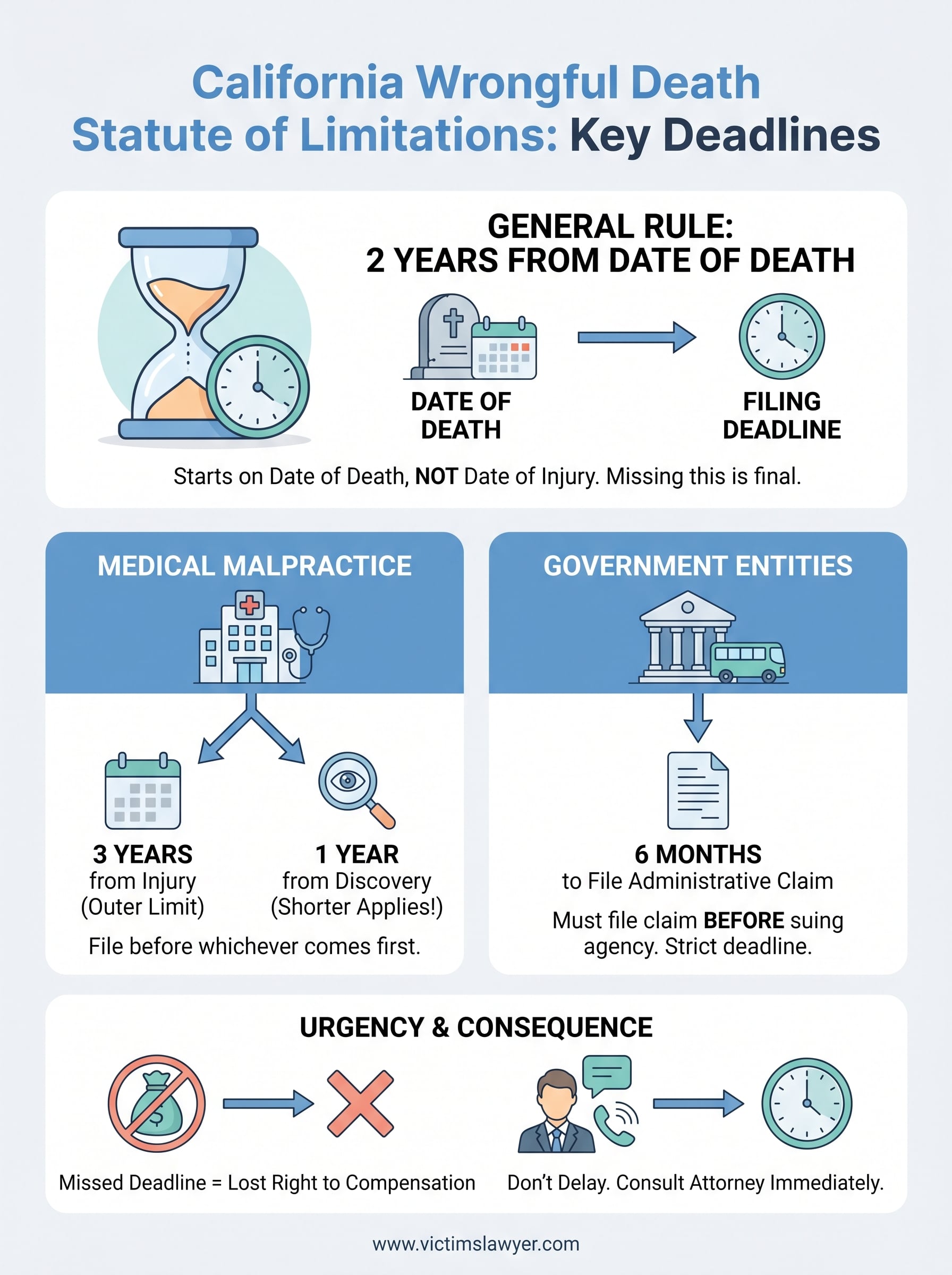
Under California Code of Civil Procedure Section 335.1, wrongful death claimants have two years from the date of the deceased person’s death to file a lawsuit. This baseline rule applies to the large majority of wrongful death cases filed in California. Importantly, the california wrongful death statute of limitations does not measure time from the date of the accident or the original injury; it measures time from the actual date of death, which may occur days, weeks, or even months after the incident that caused the fatal harm.

The two-year period begins on the date of death, not the date of the injury or accident.
Who can file and when their deadline begins
California law strictly limits the people who have legal standing to file a wrongful death lawsuit. The two-year period begins on the same date for all of them: the date of death. Eligible parties under California Code of Civil Procedure Section 377.60 include:
- Surviving spouse or domestic partner
- Children of the deceased
- Grandchildren, if the decedent’s children are also deceased
- Dependent parents or siblings, if no other eligible heirs exist
Each eligible claimant’s two-year window opens on the same date, regardless of when that individual personally learned about the death or its cause.
When the date of death differs from the accident date
Many families mistakenly believe their deadline starts on the date of the accident, but this is incorrect. If your loved one was injured on January 5 and died from those injuries on March 20, your two-year clock begins on March 20, not January 5.
You must document both the incident date and the certified date of death to calculate your actual filing deadline accurately, since courts use that official document to confirm when your limitation period began.
How to calculate your deadline in real situations
Calculating your actual filing deadline requires two confirmed dates: the official date of death and the date you plan to file. Once you have both, the math is simple. Add two years to the date of death, and that is your last possible day to file under the standard rule. But confirming those dates accurately, especially the date of death, requires getting a certified death certificate, not relying on memory or informal records.
A straightforward example
Suppose your spouse was struck by a negligent driver and died at the hospital on August 14, 2024. Under California Code of Civil Procedure Section 335.1, your two-year period expires on August 14, 2026. You do not count the accident date, the date of hospitalization, or the date you retained an attorney. The death certificate controls the start of your window, and your attorney must file the lawsuit before that date closes.
Filing even a single day late permanently bars your claim, which is why you should confirm your exact deadline in writing with your attorney as early as possible.
When the injury and death dates are far apart
Some families deal with situations where a loved one survived for months after an accident before dying from related complications. In those cases, the california wrongful death statute of limitations still starts from the date of death, not the original injury. If your father was injured on March 1, 2023, but passed away on November 10, 2023, your filing deadline is November 10, 2025. You gain time compared to counting from the accident, but you must use the correct start date or risk miscalculating the window entirely.
Special deadlines for medical malpractice wrongful deaths
When a loved one dies because of a doctor’s or hospital’s negligence, the california wrongful death statute of limitations applies differently than in standard accident cases. California Code of Civil Procedure Section 340.5 governs medical malpractice claims, and it imposes either a three-year period from the date of injury or one year from the date you discovered, or reasonably should have discovered, the negligence, whichever comes first.
How the three-year and one-year rules interact
Both timelines run simultaneously, and you must file before whichever deadline arrives first. If your loved one died in a hospital on June 1, 2024, and you suspected malpractice immediately, your one-year window closes on June 1, 2025, which arrives before the three-year outer limit.

In medical malpractice wrongful death cases, the one-year discovery rule often shortens your window far below the standard two-year period.
Waiting to confirm your suspicions does not restart the one-year clock; it runs from the point when a reasonable person would have connected the death to the provider’s negligence. Courts apply an objective standard to that determination, not a subjective one based on your personal awareness.
What qualifies as a medical malpractice wrongful death
A wrongful death qualifies under medical malpractice rules when it stems directly from a licensed healthcare provider’s negligent act or omission, such as a surgical error, a misdiagnosis, or a medication mistake. If the death resulted from a combination of an accident and subsequent hospital negligence, your attorney will need to analyze both timelines to determine which statute controls. Getting this analysis wrong can result in filing under the longer standard rule while the shorter malpractice deadline has already expired, which permanently bars your claim.
Shorter deadlines when a government agency is involved
When the death involved a government employee or agency, such as a city bus driver, a county hospital, or a state worker, the california wrongful death statute of limitations does not apply in the same way. California’s Government Claims Act requires you to file an administrative claim with the responsible agency before you can even file a lawsuit. You typically have only six months from the date of death to submit that claim, which is dramatically shorter than the standard two-year period.
Missing the six-month government claim deadline bars you from suing the agency entirely, regardless of how strong your evidence is.
Filing a government claim before you can sue
Before you file a lawsuit against a government entity, you must submit a written claim directly to that agency. The agency then has 45 days to accept or reject it. If they reject your claim, you have six months from the rejection date to file your lawsuit in court. If the agency does not respond at all, a two-year period from the incident applies, but waiting that long is unnecessary and creates avoidable risk.
Your claim must include specific details to be valid: the date and location of the incident, a description of how the death occurred, and the names of eligible heirs. Submitting an incomplete or late claim typically results in rejection, and courts rarely allow families to proceed against a government defendant without completing this step first.
What counts as a government entity
A government entity includes any city, county, state agency, public school district, or publicly operated hospital functioning under California law. If your loved one was struck by a city-owned vehicle or died due to negligent care at a county medical facility, the Government Claims Act applies. Many families do not realize that a municipal transit authority or a publicly run clinic triggers these shorter administrative deadlines, which makes identifying the correct defendant an urgent first step.
What to do if you may be running out of time
If you believe your deadline is approaching, contact an attorney immediately rather than waiting until you have every document ready. The california wrongful death statute of limitations leaves no room for delays, and an attorney can confirm your exact deadline, identify which exceptions apply to your case, and file the necessary paperwork before your window closes.
Gathering your certified death certificate and any incident-related records before your consultation helps your attorney calculate your precise filing date without guessing. Every day you delay after losing a family member is a day closer to permanently losing your legal remedy, whether through the standard two-year rule, the malpractice timeline, or the six-month government claims deadline.
Speak with our wrongful death attorneys today at Steven M. Sweat, Personal Injury Lawyers, APC for a free 24/7 consultation with no fees unless we recover compensation for your family.