- Free Consultation: 866-966-5240 Tap Here To Call Us












California Vehicle Code Pedestrian Right Of Way: Explained


Article Summary: California’s Vehicle Code establishes a framework of shared responsibility between drivers and pedestrians, primarily through statutes CVC 21950 and CVC 21954. CVC 21950 mandates that drivers yield to pedestrians in both marked and unmarked crosswalks, with the latter defined by law at nearly any intersection. However, pedestrians are prohibited from abruptly stepping into traffic where a driver cannot reasonably stop. Conversely, CVC 21954 requires pedestrians crossing outside of designated crosswalks to yield to motorists. Because California follows a pure comparative fault system, the specific location and circumstances of a collision directly influence liability and potential compensation. Insurance companies frequently leverage these codes to assign higher fault percentages to pedestrians, thereby reducing settlement payouts for medical expenses and lost wages. Even in mid-block scenarios, factors like driver distraction or speeding can shift liability back toward the motorist. Understanding these legal nuances is essential for injured parties seeking to counter insurance company tactics and secure full recovery for serious injuries. Documenting the scene and consulting legal expertise are critical steps in navigating these complex right-of-way disputes to ensure a fair outcome under state law.
As Los Angeles Pedestrian Accident Attorneys, we see first hand that, every year, thousands of pedestrians are struck by vehicles on California streets, and in many of those cases, the question of who had the legal right to be where they were becomes central to the outcome. Understanding the California Vehicle Code pedestrian right of way rules isn’t just an academic exercise. It directly affects who bears liability when a collision happens and how much compensation an injured person can recover.
California law doesn’t give pedestrians a blanket right to cross wherever and whenever they want. It also doesn’t give drivers free rein to barrel through crosswalks. Instead, statutes like CVC 21950 and CVC 21954 create a framework of shared responsibility, one that shifts depending on whether the pedestrian is in a marked crosswalk, at an unmarked intersection, or crossing mid-block. The specifics matter, especially when an insurance company is looking for any reason to reduce or deny a claim.
At Steven M. Sweat, Personal Injury Lawyers, APC, we’ve spent over 30 years representing pedestrians throughout Los Angeles and across California who have suffered serious injuries because a driver failed to yield. We’ve seen firsthand how misunderstandings about right-of-way laws get weaponized against injured people, and how knowing the actual code provisions can make the difference between a lowball offer and full compensation for medical bills, lost wages, and pain. This article breaks down exactly what California’s Vehicle Code says about pedestrian right of way, when pedestrians must yield, and what it all means if you’ve been hit.
Why pedestrian right of way laws matter in California
California has one of the highest pedestrian fatality rates in the country. According to the California Office of Traffic Safety, pedestrians represent a disproportionately high percentage of overall traffic deaths statewide each year. When a collision happens, the police report, the insurance adjuster, and ultimately a jury all look to the California Vehicle Code pedestrian right of way framework to assign fault. How the law reads, and how it applies to your specific facts, determines whether you recover fair compensation or end up with nothing.
The outcome of a pedestrian injury claim often hinges less on the severity of your injuries and more on whether the law placed you or the driver at fault in that specific location at that specific moment.
The scale of the problem on California streets
Urban areas like Los Angeles, San Francisco, and San Diego record some of the country’s worst pedestrian injury and fatality numbers each year, with intersections, crosswalks, and mid-block locations all presenting serious hazards. The combination of high vehicle speeds, distracted drivers, and dense pedestrian populations creates conditions where knowing exactly what the law requires is not optional. For anyone regularly walking California streets, these rules carry real consequences.
The state has responded with targeted enforcement programs and infrastructure improvements across major corridors, but the legal framework that governs who bears responsibility for a collision has remained anchored in the same core Vehicle Code provisions for decades. If you are injured, those provisions become the foundation of your entire claim, and no amount of physical evidence fully replaces a clear understanding of what the law actually demands from both drivers and pedestrians in each specific scenario.
How fault allocation affects what you recover
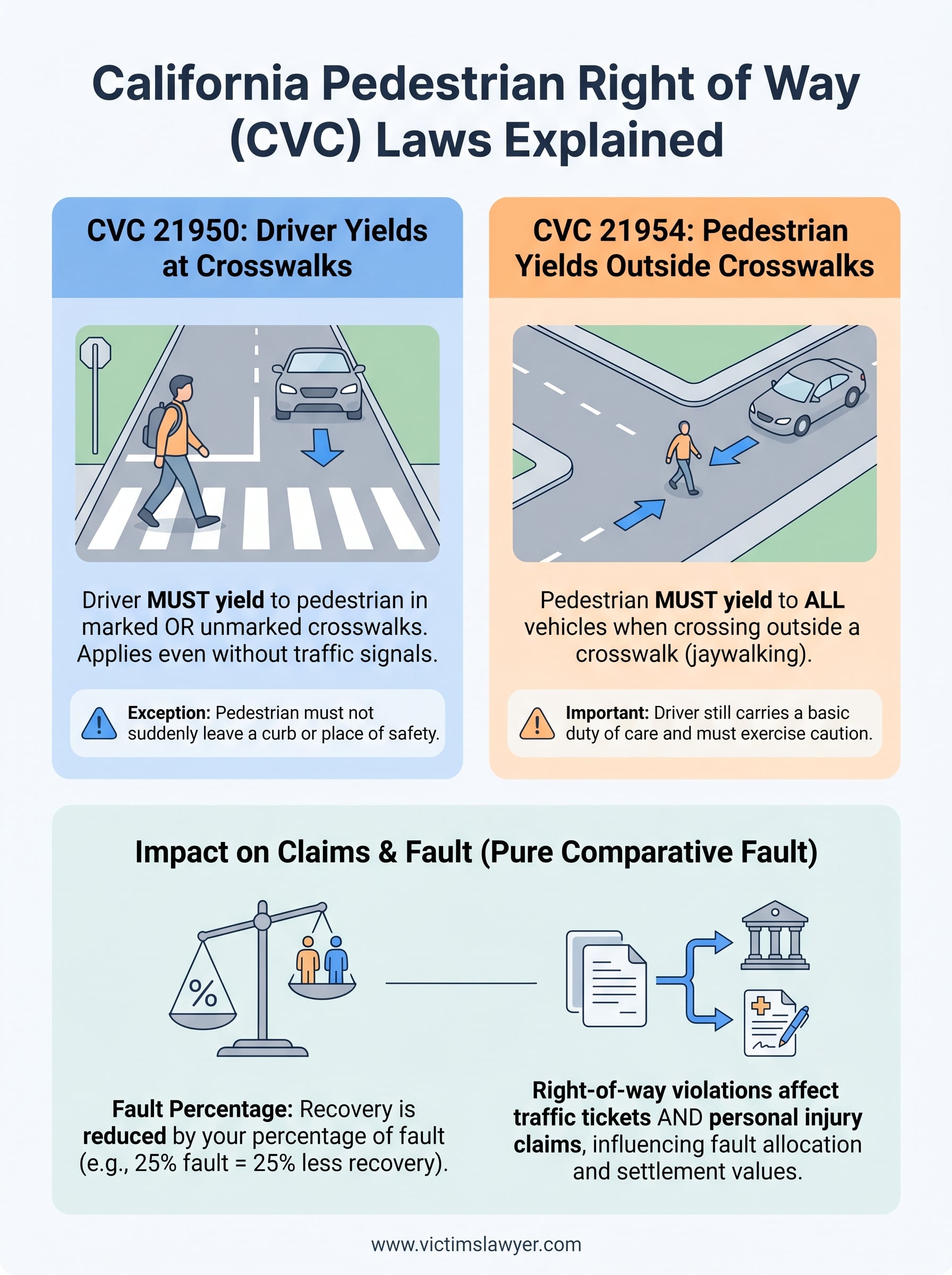
California follows a system of pure comparative fault, which means that even if you share some responsibility for a collision, you can still recover damages. However, your recovery is reduced by your percentage of fault. For example, if a jury finds you were 25 percent at fault for crossing outside a marked crosswalk, your total damages award gets reduced by that same 25 percent.
Insurance companies invest significant resources into building a narrative that places blame on the pedestrian. They know that even a modest shift in fault percentage translates directly into dollars saved on a settlement payout. Understanding precisely where the Vehicle Code places the duty of care on the driver, and where it places responsibility on the pedestrian, gives you the factual foundation to challenge those arguments and protect the full value of your claim.
What CVC 21950 requires at crosswalks
California Vehicle Code Section 21950 is the primary statute governing the california vehicle code pedestrian right of way at crosswalks. The law requires a driver to yield the right of way to any pedestrian crossing in a marked crosswalk or in an unmarked crosswalk at an intersection. This obligation applies whether traffic signals are present or not, and it places an affirmative duty on the driver to stop and remain stopped until the pedestrian has completely cleared the driver’s lane and the lane immediately adjacent to it.
What counts as a marked versus unmarked crosswalk
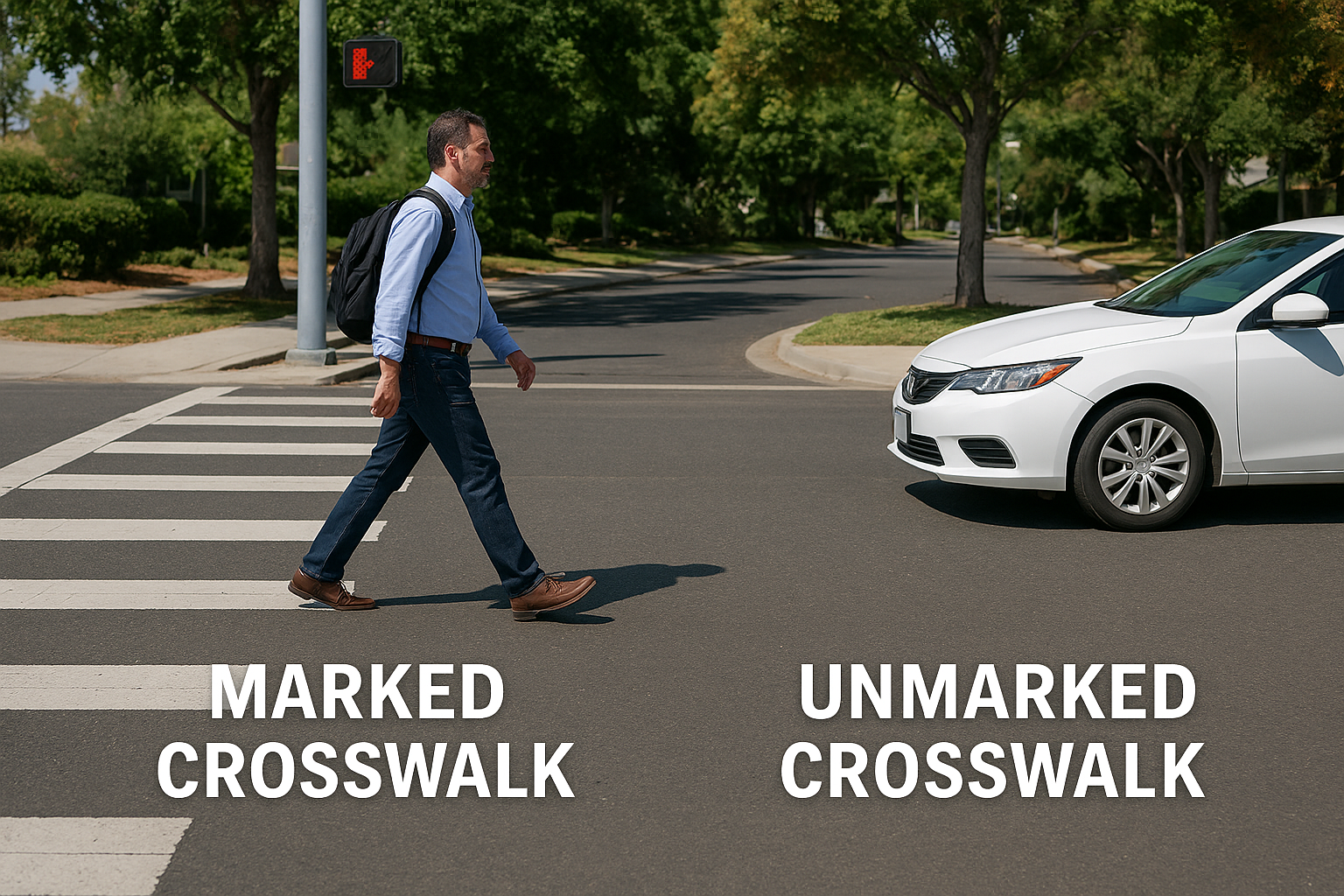
A marked crosswalk is a designated crossing area painted onto the road surface, typically with white lines at an intersection or at a mid-block location. An unmarked crosswalk exists by operation of law at any intersection where two roads meet at roughly right angles, even when no painted lines appear on the pavement. Many pedestrians don’t realize they carry legal crosswalk protections at these unmarked locations, and many drivers don’t realize they carry the same yielding obligation there as they do at a painted crossing.
The limits the statute places on pedestrians
CVC 21950 does not make the crosswalk a zone where you can act without any responsibility. The statute specifically states that a pedestrian must not suddenly leave a curb or other place of safety and move into the path of a vehicle so close that the driver cannot yield in time. This provision matters significantly in personal injury claims, because an insurance adjuster will often argue that you stepped out abruptly and left the driver no reasonable opportunity to stop. Whether that argument holds up in your specific case depends on the facts, including vehicle speed, sight lines, and your actual movements before the collision.
If the driver was speeding or distracted, the “sudden movement” defense loses much of its weight in court.
When pedestrians must yield under CVC 21954
CVC 21954 is the counterpart to CVC 21950, and it places specific yielding obligations on pedestrians who cross outside of a marked or unmarked crosswalk. Under this statute, when you cross a roadway at any point other than a crosswalk, you must yield the right of way to all vehicles on the road. The law recognizes that drivers have a reduced expectation of encountering foot traffic mid-block and cannot reasonably be expected to react the same way as they would at a designated crossing.
What “outside a crosswalk” actually means
Crossing outside a crosswalk covers mid-block crossings where no intersection exists, as well as crossings at intersections where you bypass the marked or unmarked crosswalk entirely. When you step into the road between two intersections, the california vehicle code pedestrian right of way framework shifts so the obligation to avoid a collision rests primarily with you rather than the driver.
Your location in the road directly affects how fault is assigned in any subsequent injury claim. Insurance companies will use a mid-block crossing to argue that your percentage of fault is significantly higher than it would be inside a crosswalk.
Even when you cross outside a crosswalk, a driver who was speeding, impaired, or distracted can still be found liable for your injuries.
How CVC 21954 interacts with comparative fault
CVC 21954 does not eliminate a driver’s basic duty of care. California courts have consistently held that drivers must exercise reasonable care at all times, even when a pedestrian is jaywalking. However, your fault percentage in a mid-block crossing scenario will typically be higher, and insurance adjusters will use that fact as leverage to reduce your settlement.
Working with an attorney means someone can identify all contributing factors, including whether the driver was speeding, had an unobstructed view, or had adequate time to brake before impact.
How the rules apply in common real-world situations
Abstract legal language becomes clearer when you apply it to the scenarios you actually encounter on California streets. The california vehicle code pedestrian right of way rules operate differently depending on where and how you cross, and understanding those distinctions helps you recognize when a driver violated a legal duty and when shared responsibility becomes a factor in your case.
Crossing at a signalized intersection
When you cross at a signalized intersection with a pedestrian walk signal, you hold the right of way under CVC 21950, and any driver who fails to yield is in violation of the law. This covers both the driver turning left across your path and the driver turning right while you step off the curb. If a vehicle strikes you while you are in the crosswalk with a valid walk signal, driver fault is strongly supported by both the Vehicle Code and the physical evidence.
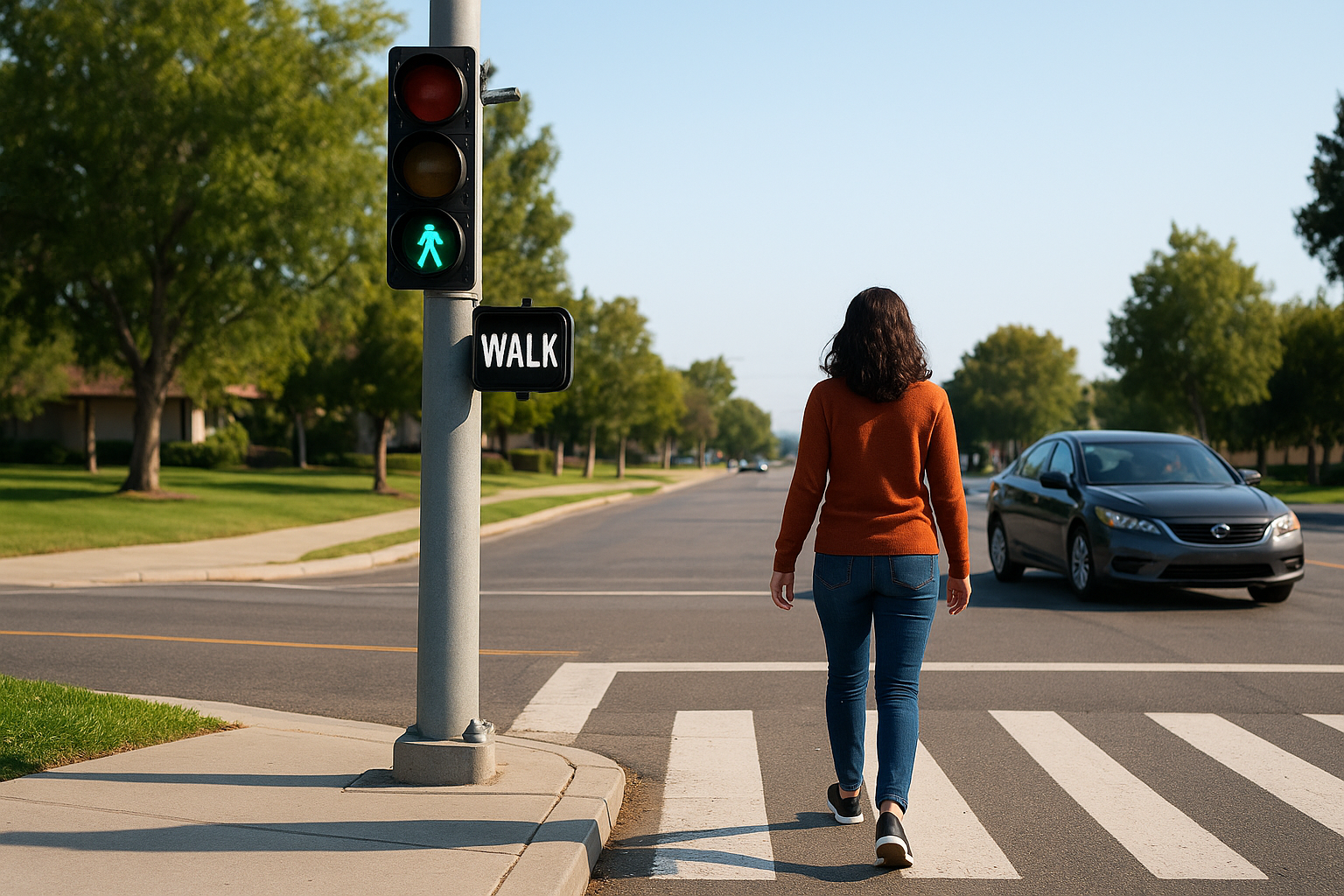
A driver who ignores a walk signal faces significant liability, regardless of what the pedestrian was doing at the time.
Situations get more complex when you enter the crosswalk on a flashing don’t walk signal. You still hold a degree of crosswalk protection, but the fact that you initiated your crossing on a flashing signal can influence how fault is allocated between you and the driver if a collision occurs.
Crossing mid-block without a crosswalk
When you cross outside of any marked or unmarked crosswalk, CVC 21954 places the primary yielding obligation on you rather than on the driver. This is the scenario insurance companies use most aggressively to argue comparative fault against injured pedestrians, and that argument carries legal weight unless other factors point to driver negligence.
Your recovery still depends on whether the driver was speeding, distracted, or impaired at the time, because those factors shift fault back toward the driver even in a mid-block crossing situation.
What the right of way means for tickets and injury claims
The california vehicle code pedestrian right of way rules carry legal consequences in two distinct arenas: traffic enforcement and civil injury claims. Understanding both helps you recognize what is actually at stake when a collision occurs or when law enforcement arrives at the scene.
Is jaywalking still illegal in California? The Freedom to Walk Act
For decades, crossing outside a crosswalk could earn you a jaywalking ticket. That changed on January 1, 2023, when the Freedom to Walk Act (Assembly Bill 2147) took effect. Under the law, a police officer may no longer stop or cite a pedestrian for crossing outside a crosswalk or against a signal unless a reasonably careful person would recognize an immediate danger of a collision. In plain terms: crossing mid-block when the road is clear is no longer a ticketable offense in California — but stepping into the path of oncoming traffic still is. It is just as important to understand what the Freedom to Walk Act did not do. It did not give pedestrians the right of way outside a crosswalk, and it did not erase a pedestrian’s duty under CVC 21954 to yield to vehicles when crossing mid-block. Critically for an injury claim, it did not change California’s pure comparative fault rules — you can still be assigned a percentage of fault for where and how you crossed, and your recovery is reduced by that percentage. What changed is that the absence of a citation removes one piece of evidence insurers historically used against pedestrians, while a driver who was speeding, distracted, or impaired remains liable for the harm they cause.
How right-of-way violations translate into traffic citations
When a driver fails to yield to a pedestrian in a marked or unmarked crosswalk, that driver faces a citation under CVC 21950, which carries a base fine plus penalty assessments that can push the total cost well above $200 in California. A pedestrian who crosses mid-block can still face a citation under CVC 21954, but since the Freedom to Walk Act took effect in 2023, only when the crossing created an immediate danger of a collision. Officers at the scene use the Vehicle Code to determine who violated the law, and that citation becomes one of the first pieces of evidence your attorney will request if you file an injury claim.
A driver citation is not a guarantee of liability, but it significantly strengthens your position when negotiating with an insurance company.
How fault allocation shapes your injury claim
In a personal injury case, the right-of-way determination directly drives how fault percentages are assigned between you and the driver. California’s pure comparative fault system means your attorney will argue that the driver bore the primary duty of care, while the opposing insurer will search for any Vehicle Code provision that shifts responsibility to you. Evidence like surveillance footage, witness statements, and physical measurements of the crosswalk location all feed into that analysis.
Your attorney’s ability to cite the specific statute the driver violated, and to counter any argument that you bore responsibility for the collision, shapes the final settlement value. Injuries like fractures, traumatic brain injuries, and spinal damage carry enormous long-term costs, and every percentage point of fault that shifts to you reduces what you ultimately recover.
Frequently Asked Questions
Q: Is jaywalking illegal in California?
Since the Freedom to Walk Act took effect on January 1, 2023, police can no longer cite a pedestrian for crossing outside a crosswalk unless the crossing created an immediate danger of a collision. Safe mid-block crossing is no longer a ticketable offense — but you still must yield to traffic under CVC 21954.
Q: Can I still recover compensation if I was jaywalking when I was hit?
Yes. California follows pure comparative fault, so you can recover even if you were partly at fault — your damages are reduced by your percentage of fault, not eliminated. If the driver was speeding, distracted, or impaired, they remain liable regardless of where you crossed.
Key takeaways and next steps
The california vehicle code pedestrian right of way framework divides responsibility between drivers and pedestrians based on your specific location and conduct at the time of a collision. CVC 21950 places a strong duty on drivers to yield at marked and unmarked crosswalks, while CVC 21954 shifts the primary yielding obligation to pedestrians crossing outside of crosswalks. California’s pure comparative fault system means fault percentages directly reduce what you recover, and insurance companies will use every Vehicle Code provision available to push that percentage toward you.
Your first step after any pedestrian collision is to document everything you can, including the exact crossing location, any traffic signals present, and witness contact information. An experienced personal injury attorney can identify which statutes apply to your specific facts and build the strongest argument for full compensation. Contact our team for a free consultation and find out exactly where you stand.