- Free Consultation: 866-966-5240 Tap Here To Call Us













What To Do After A Bicycle Accident: California Steps


A bicycle accident can turn an ordinary ride into a chaotic, disorienting experience in seconds. Whether you were commuting through Los Angeles traffic or enjoying a weekend ride along the coast, knowing what to do after a bicycle accident can significantly impact your physical recovery and your ability to seek compensation. In those critical moments following a collision, the decisions you make matter, both for your health and for any potential legal claim.
California sees thousands of bicycle accidents each year, and cyclists often face serious injuries ranging from road rash and broken bones to traumatic brain injuries. Unlike drivers protected by steel frames and airbags, cyclists absorb the full force of impact. That vulnerability makes proper post-accident steps even more important. Taking the right actions protects your legal rights while ensuring you get the medical attention you need.
At Steven M. Sweat, Personal Injury Lawyers, APC, we’ve spent over 25 years representing injured cyclists throughout California. We’ve seen how insurance companies minimize claims when victims don’t properly document their accidents, and we’ve helped clients recover substantial compensation when they follow the right procedures from the start. Our team understands California bicycle accident law and the specific challenges cyclists face when pursuing injury claims.
This guide walks you through each step you should take after a bicycle accident in California, from the immediate aftermath at the scene to filing an insurance claim and protecting your right to compensation. Whether you’re dealing with minor scrapes or a life-changing injury, these steps will help you navigate what comes next.
What to do first after a bicycle accident in California
The moments immediately following a bicycle collision determine both your physical safety and the strength of any future legal claim. Your first priority is stopping at the scene, no matter how minor the collision seems. Under California Vehicle Code Section 20001, leaving the scene of an accident that causes injury or death is a criminal offense, even if you weren’t at fault. This applies to cyclists just as it does to drivers.
Your first 60 seconds after impact
Stop pedaling and bring yourself to a complete halt as soon as you can safely do so. Your body may be flooded with adrenaline, which can mask serious injuries and create a false sense that you’re fine. Check your surroundings before you move, especially if you’re still in an active traffic lane. Broken bones or internal injuries might not be immediately obvious, but moving hastily could worsen your condition.
If you can stand and move without severe pain, get yourself out of the roadway if you’re in danger from oncoming traffic. If you cannot move without significant pain, stay where you are and signal to others for help. Your immediate safety takes precedence over everything else in these first seconds.
Stay at the scene as required by law
California law requires you to remain at the accident location until you’ve exchanged information with the other parties involved. This applies whether a car hit you, you collided with a pedestrian, or you struck a parked vehicle. Leaving the scene before fulfilling this legal obligation can result in criminal charges against you, regardless of who caused the collision.
California’s hit-and-run laws apply to cyclists, meaning you can face misdemeanor or felony charges if you leave before exchanging information or rendering aid.
You must provide your name, address, and contact information to the other party. If you damaged someone’s property (like a parked car or a fence), you need to leave a written note with your information if the owner isn’t present. These requirements exist to protect everyone involved and ensure accountability after an accident.
Assess immediate dangers around you
Once you’ve stopped and determined you can stay conscious and alert, quickly scan the area for continuing hazards. Are vehicles still approaching? Is your bicycle creating an obstruction that could cause a second collision? Can other drivers see you, especially if the accident happened at dusk or in poor weather? Traffic flow around an accident scene can be unpredictable, and drivers may not immediately notice a cyclist on the ground.
If you have the ability, move your bicycle to the shoulder or sidewalk to prevent additional crashes. Do not move the bike far from the collision point, as its position serves as evidence. Just shift it enough to clear the active roadway if doing so prevents further danger.
Turn on any lights or reflectors you have with you to increase your visibility. If you carry a phone, turn on its flashlight. Signal to approaching traffic with your hands if necessary. Your goal in these first moments is preventing what to do after a bicycle accident from becoming what to do after a second, worse accident.
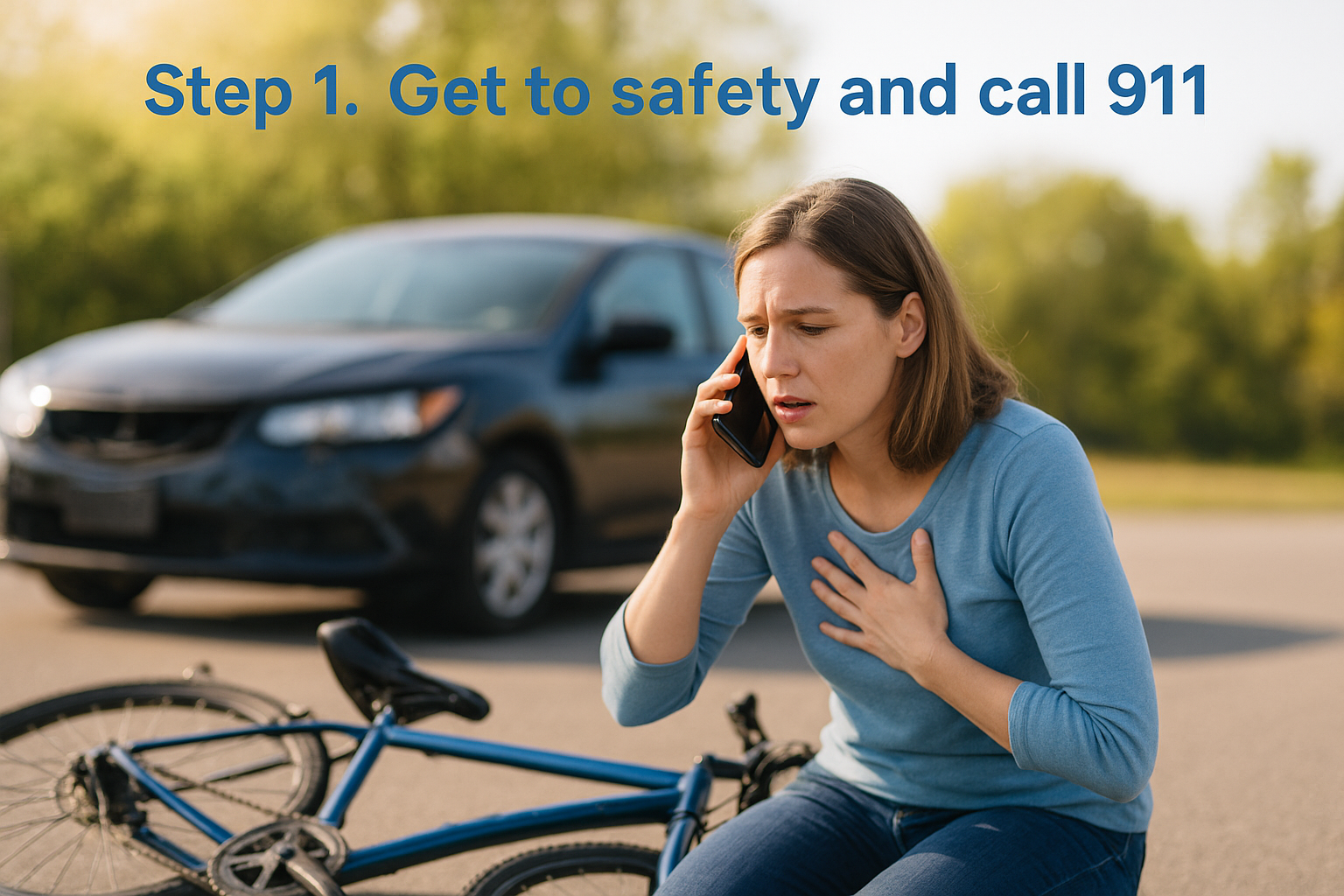
Step 1. Get to safety and call 911
Once you’ve stopped at the scene and identified immediate hazards, your next action is calling for emergency help. California law requires you to report any accident that causes injury, death, or property damage exceeding $1,000, and calling 911 ensures that both medical responders and law enforcement arrive at the scene. This call creates an official record of the incident, which becomes vital evidence for your insurance claim and any potential legal action. Even if your injuries seem minor or the other party suggests handling things privately, making that 911 call protects your rights and ensures proper documentation.
When to dial 911 immediately
You should contact emergency services without delay if anyone at the scene shows signs of serious injury. Call 911 if you or anyone else experiences severe pain, bleeding that won’t stop, difficulty breathing, loss of consciousness, confusion, or an inability to move body parts. Head injuries require immediate medical evaluation, even if the person seems alert, because traumatic brain injuries can worsen rapidly.
Adrenaline can mask serious injuries for hours after a bicycle accident, making immediate medical assessment critical even when you feel fine.
California Vehicle Code Section 20008 requires drivers to immediately report accidents resulting in injury or death. As a cyclist, you benefit from this requirement because it brings police documentation to the scene. Don’t let the other driver talk you out of calling. Insurance companies give far more weight to official police reports than to after-the-fact claims filed days later.
What to tell the emergency dispatcher
When you reach the 911 operator, provide clear, specific information to ensure appropriate response. State that a bicycle accident occurred, give your exact location (use cross streets or landmarks if you don’t know the address), and describe any visible injuries. The dispatcher needs to know how many people require medical attention and whether anyone is unconscious or trapped.
Use this information checklist when speaking with 911:
- Your precise location (intersection, street address, or nearby landmarks)
- Number of people involved (cyclist, driver, passengers, pedestrians)
- Visible injuries and their severity
- Whether anyone lost consciousness
- Traffic hazards (blocked lanes, fluid leaks, other dangers)
- Your contact number in case the call disconnects
Stay on the line until the dispatcher tells you to hang up. Operators often provide first aid instructions while responders travel to your location. This guidance can prevent injuries from worsening while you wait for professional help to arrive at the scene.
Step 2. Check for injuries and get medical care
Your body’s response to trauma can deceive you about the true extent of your injuries. Adrenaline floods your system after a collision, creating a temporary analgesic effect that masks serious damage to your body. What feels like minor soreness at the accident scene can reveal itself as a broken collarbone or internal bleeding hours later. This physiological response makes immediate medical evaluation one of the most critical steps in what to do after a bicycle accident, even when you believe you escaped without harm.
Perform a systematic injury check
Start with your head and work downward, checking each body region methodically. Touch your scalp for bumps, tenderness, or blood. Move your neck gently to identify pain or stiffness that could indicate whiplash or vertebral damage. Check your vision for blurriness and your thinking for confusion, both signs of concussion or traumatic brain injury.
Continue your assessment using this body-region checklist:
- Head and neck: Scalp wounds, facial injuries, neck pain, dizziness
- Shoulders and arms: Limited range of motion, swelling, visible deformity
- Torso: Difficulty breathing, rib tenderness, abdominal pain
- Hips and pelvis: Sharp pain when moving or standing
- Legs and feet: Inability to bear weight, ankle swelling, knee instability
If another person was injured in the collision, help them perform the same check while you wait for paramedics. Do not move anyone who reports neck or back pain, as movement could worsen spinal injuries.
Accept ambulance transport and document everything
When paramedics arrive, accept their recommendation for hospital evaluation even if your injuries seem manageable. Insurance companies routinely deny claims when cyclists refuse immediate medical transport, arguing that the injuries must not have been serious. Your refusal becomes evidence against you in settlement negotiations.
Declining emergency medical transport creates a documentation gap that insurance adjusters exploit to minimize or deny your injury claim.
Tell the responding medics about every symptom you experience, including pain you consider minor. Mention if you lost consciousness, even briefly. Report any medications you take regularly, as they affect treatment decisions. Request copies of all medical records before you leave the hospital, because these documents become the foundation of your injury claim against the at-fault driver.
California law gives you two years to file a personal injury lawsuit after a bicycle accident, but medical documentation must begin immediately. Gaps in treatment give insurance companies ammunition to argue your injuries resulted from something other than the collision.
Step 3. Identify everyone involved and gather witnesses
Gathering accurate information from everyone present transforms a confusing accident scene into a documented incident with clear accountability. This step in what to do after a bicycle accident creates the foundation for your insurance claim and any legal action you pursue. While you wait for police to arrive, collect information from the driver who hit you, any passengers in their vehicle, and anyone who witnessed the collision. Insurance companies cannot dispute facts when multiple independent witnesses corroborate your version of events.
Get driver information and contact details
Approach the driver calmly and request their information, even if they appear hostile or attempt to leave. You need their full legal name as it appears on their license, not just what they tell you. Write down their phone number, address, and email. Record their driver’s license number and the state that issued it, along with the license plate number from their vehicle.
Collect these specific details from every driver involved:
- Full name and date of birth
- Driver’s license number and issuing state
- Current phone number and email address
- Home address
- License plate and vehicle identification number (VIN)
- Insurance company name and policy number
- Make, model, year, and color of vehicle
Ask to photograph their driver’s license and insurance card with your phone rather than copying numbers by hand. Photos eliminate transcription errors that can derail your claim when you cannot locate the at-fault driver later. If the driver refuses to provide insurance information, note their refusal and tell the responding officer.
Find and record witness statements
Scan the area immediately for people who stopped to watch or who might have seen the collision occur. Witnesses leave quickly, so identify them before police arrive and the crowd disperses. Approach pedestrians, nearby business employees, and other cyclists who may have observed the crash. Ask each person directly: “Did you see what happened?”
Witness statements collected at the scene carry far more credibility than those obtained days later when memories fade and details become uncertain.
Record each witness’s full name and phone number. Ask them to describe what they saw in their own words while you write it down or record it on your phone. Get their permission before recording. Note their position when the accident occurred, because location affects what they could actually observe. If a witness agrees, ask them to wait and speak with police officers when they arrive at the scene.
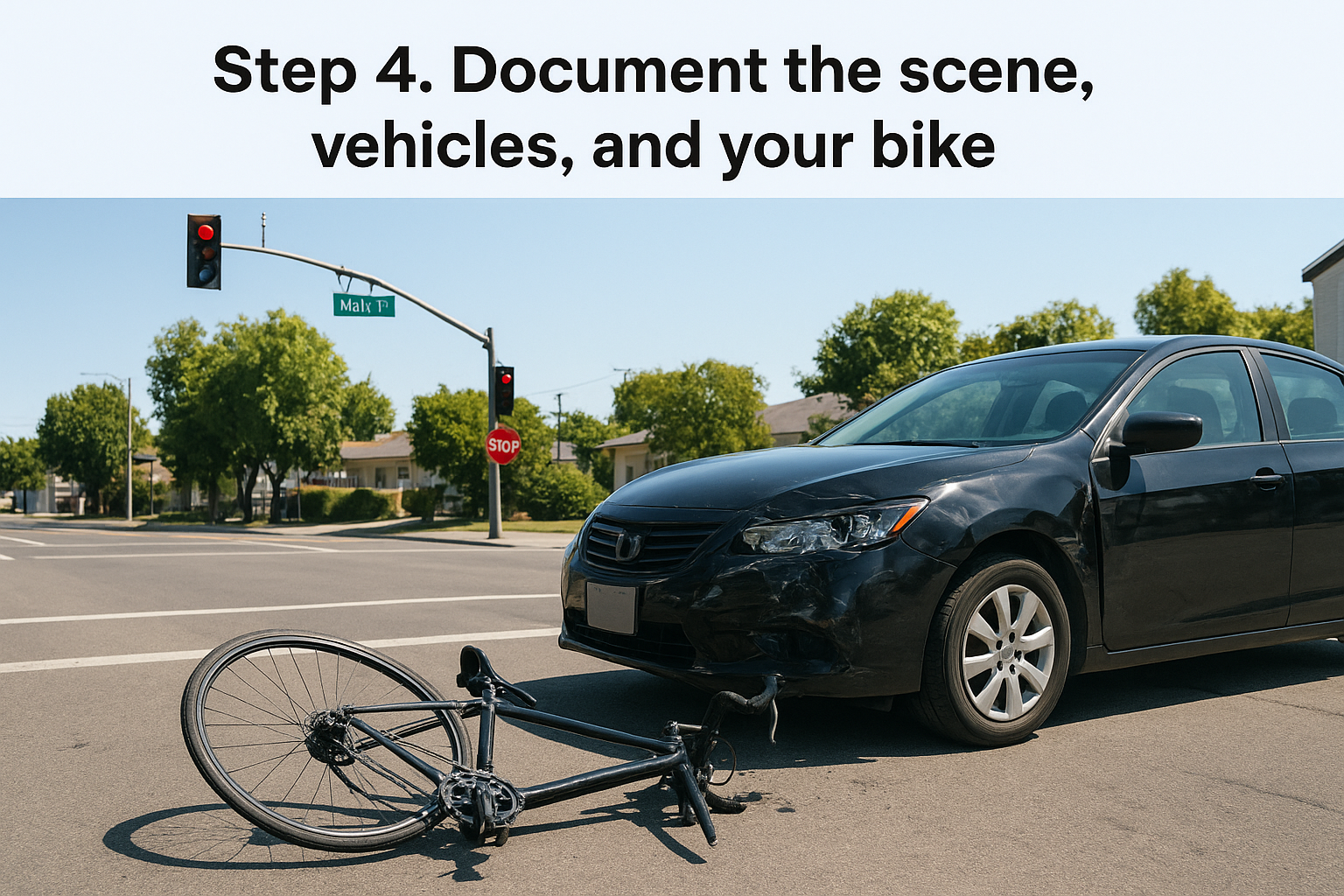
Step 4. Document the scene, vehicles, and your bike
Visual evidence collected at the accident scene prevents insurance companies from disputing the facts of your collision. This step in what to do after a bicycle accident transforms eyewitness accounts into irrefutable proof of how the crash occurred and who bears responsibility. Your smartphone camera becomes your most valuable tool at this moment, capturing details that human memory cannot preserve accurately. Take photos before vehicles move, before debris gets swept away, and before weather conditions change the scene.
Photograph the complete accident scene
Start by capturing wide shots that show the entire intersection or roadway where the collision happened. Stand in multiple positions to photograph the scene from different angles. Include traffic signals, street signs, crosswalks, and lane markings in your photos. These images establish the traffic control devices present and demonstrate whether the driver had a clear line of sight to see you before impact.
Document these critical scene elements with your camera:
- All four directions of the intersection or road segment
- Traffic signals and their current status
- Stop signs, yield signs, and bike lane markings
- Skid marks, debris, and fluid leaks on the pavement
- Weather and lighting conditions
- Road surface defects like potholes or gravel
- Your bicycle’s final position relative to the vehicle
Move closer to capture detailed shots of specific hazards or features that contributed to the crash. If a pothole caused you to swerve, photograph it with a dollar bill or shoe next to it for size reference. Take photos of any obstructions that blocked the driver’s view, such as parked vehicles or overgrown vegetation.
Document all vehicle and bicycle damage
Photograph every vehicle involved from all four sides. Capture close-up images of dents, scratches, broken glass, and paint transfer that resulted from the collision. These damage patterns reveal the point of impact and the force involved. Take shots of the vehicle’s license plate in each photo to prevent disputes about which vehicle struck you.
Damage locations on both your bicycle and the vehicle create a mechanical fingerprint of exactly how the collision occurred, making it nearly impossible for insurance companies to deny liability.
Turn your camera to your bicycle and photograph all damage from multiple angles. Document bent wheels, broken spokes, frame cracks, torn saddles, and damaged handlebars. Include shots of your helmet if it shows impact marks, and photograph torn or bloodied clothing while you still wear it. These images prove the severity of impact your body absorbed during the crash.
Step 5. Report the crash and get the police report
Filing an official report creates a government-verified record of your bicycle accident that insurance companies cannot ignore. California law requires you to report any collision causing injury, death, or property damage exceeding $1,000 to the California Highway Patrol or local police within 24 hours. This legal requirement exists whether police responded to the scene or not, making it a crucial component of what to do after a bicycle accident. Your compliance protects your right to file an insurance claim and establishes an official timeline of events that adjusters cannot dispute.
File a traffic collision report within 24 hours
California Vehicle Code Section 16000 mandates that you submit a Traffic Collision Report (form SR-1) to the Department of Motor Vehicles within 10 days of any accident involving injury or significant damage. If police came to your accident scene, they typically file this report for you. However, if no officer responded or if you’re unsure whether they filed, you must complete and submit the form yourself to avoid license suspension.
Download the SR-1 form directly from the California DMV website and complete these required sections:
- Your personal information (name, address, driver license number)
- Date, time, and exact location of the collision
- Description of how the accident occurred
- Driver information for all vehicles involved
- Insurance company names and policy numbers
- Injury details for all parties
- Property damage estimates
Failing to file the required collision report within 10 days triggers an automatic driver’s license suspension by the California DMV, regardless of fault.
Mail your completed SR-1 to the address printed on the form or submit it at any DMV field office. Keep a copy for your records and note the date you submitted it. This documentation proves you met your legal obligation and protects you from license penalties.
Obtain your copy of the police report
Police reports typically become available seven to ten business days after the accident. Contact the law enforcement agency that responded to request your copy. You need the report number, accident date, and location to retrieve it. Most California police departments charge between $10 and $25 for collision report copies.
Request your report through the department’s records division by phone, in person, or through their online portal if available. The report contains the officer’s diagram of the accident, statements from all parties, witness accounts, and the officer’s determination of fault. This document becomes your primary evidence when negotiating with insurance companies or filing a lawsuit.
Step 6. Handle hit-and-run and uninsured drivers
Discovering that the driver who hit you fled the scene or carries no insurance transforms your injury claim into a more complex process. California sees thousands of hit-and-run accidents each year, and approximately 15% of California drivers operate vehicles without required insurance coverage. These situations require different tactics in what to do after a bicycle accident, but you still have legal options for recovering compensation. Your own insurance policy becomes your primary resource, and the evidence you collected at the scene becomes even more valuable for tracking down phantom drivers.
Document everything when drivers flee
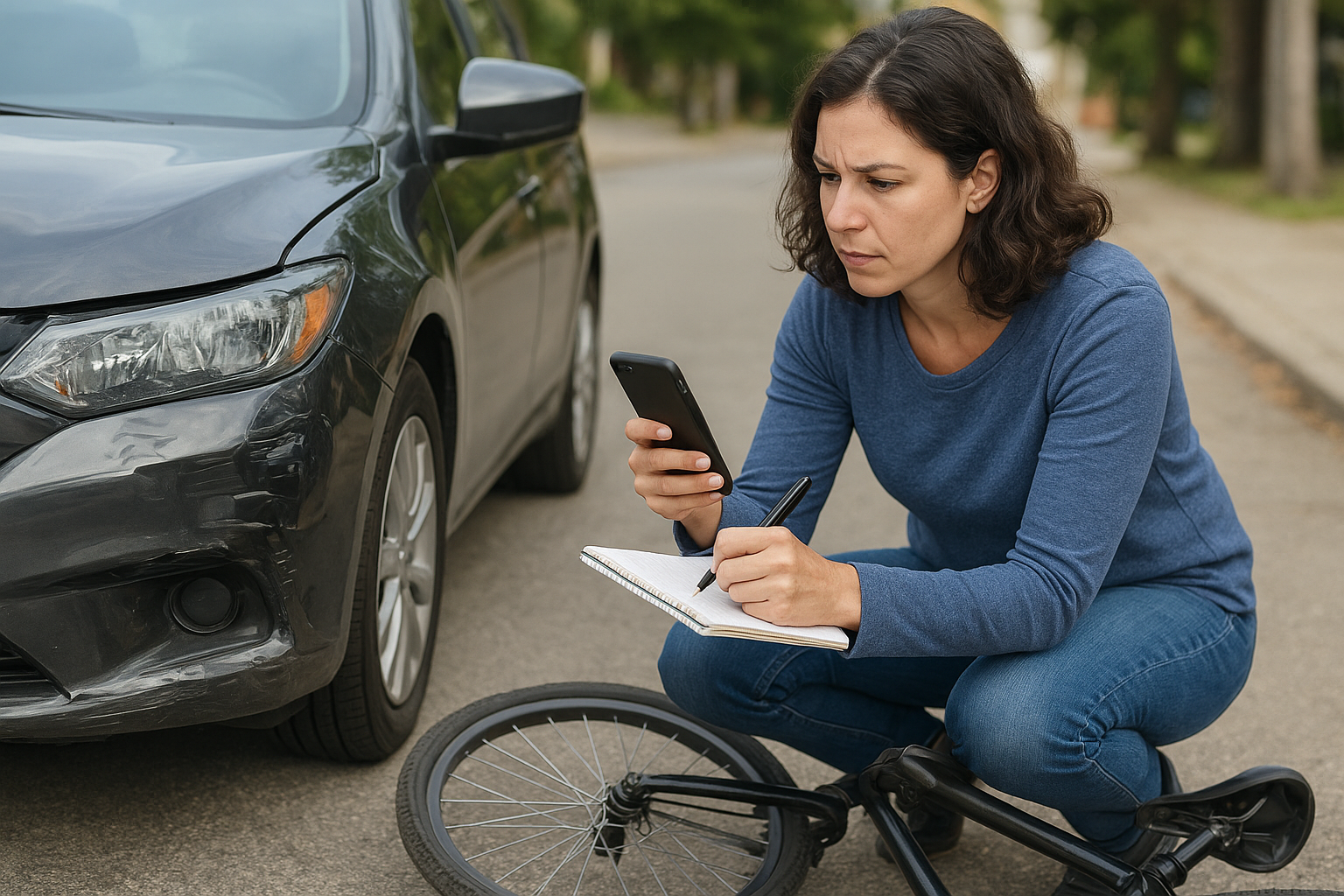
When a driver leaves before police arrive, immediately write down every detail you can remember. Record the vehicle’s make, model, color, and license plate number, even if you only caught partial digits. Note any distinguishing features like bumper stickers, damage, or company logos. Write down the direction the vehicle traveled and the time of day, because security cameras in nearby businesses might have captured footage.
Contact the police immediately and report the hit-and-run. California Vehicle Code Section 20001 makes leaving an injury accident scene a criminal offense, which means law enforcement actively investigates these cases. Provide officers with all the information you collected. Ask nearby businesses, homeowners, and other witnesses if their security cameras recorded the collision. Footage often captures license plates that eyewitnesses missed.
Filing a hit-and-run police report triggers a criminal investigation that can help identify the driver, making evidence collection at the scene absolutely critical.
Request that police check for traffic cameras or automated license plate readers in the area. Many California cities maintain camera networks that record traffic flow at major intersections. This footage can identify vehicles that passed through the area during the timeframe of your accident.
File a claim with your uninsured motorist coverage
Check your automobile insurance policy for uninsured motorist coverage (UM) and underinsured motorist coverage (UIM). These coverages protect you when the at-fault driver has no insurance or insufficient coverage limits. Even though you were riding a bicycle, your car insurance policy typically extends UM/UIM protection to you as a cyclist.
Contact your insurance company within 24 hours to report the accident and start your uninsured motorist claim. Provide them with the police report number, all evidence you collected, and your medical records. Your insurer investigates hit-and-run claims to verify that an unidentified driver caused your injuries before paying benefits under your policy.
Step 7. Protect your insurance and injury claim
Insurance adjusters start working against your interests within hours of receiving your accident report. Their goal is paying you the minimum amount possible or denying your claim entirely, and they use sophisticated tactics to achieve this. Understanding what to do after a bicycle accident includes recognizing these strategies and protecting yourself from statements or actions that destroy your claim’s value. Your cooperation with your own insurance company is necessary, but the other driver’s insurer is not your friend, regardless of how sympathetic they sound on the phone.
Decline recorded statements from opposing insurers
The other driver’s insurance company will contact you quickly, often within 24 to 48 hours of the accident. An adjuster will call expressing concern for your wellbeing and requesting a recorded statement about how the collision occurred. Politely refuse this request. Recorded statements give adjusters ammunition to twist your words and use them against you later in the claims process.
Tell the adjuster exactly this: “I’m recovering from my injuries and not ready to give a statement. Please direct all communication through my attorney.” Keep your response brief and repeat it each time they call. You have no legal obligation to provide a statement to the at-fault driver’s insurance company, despite what their adjuster implies.
Insurance companies use recorded statements to lock you into a version of events before you fully understand your injuries, then use inconsistencies to deny your claim months later.
Your own insurance company has a different relationship with you because of your policy contract. You must cooperate with your insurer’s reasonable requests, including providing a statement about the accident. However, you can still protect yourself by reviewing your policy, sticking to facts, and avoiding speculation about fault or injury severity.
Refuse to sign blanket medical authorizations
The opposing insurance company will send you forms requesting authorization to access your complete medical history, often dating back five or ten years. Do not sign these documents. These authorizations let adjusters search for any pre-existing condition they can blame for your current injuries, turning a legitimate claim into a dispute about whether the accident actually caused your pain.
Provide medical records only through your attorney, who will release relevant treatment records that directly relate to your bicycle accident injuries. This protects your privacy while giving the insurance company the information they legitimately need to evaluate your claim.
Step 8. Track treatment, symptoms, and expenses
Creating a detailed record of your injuries, medical treatment, and financial losses strengthens your compensation claim significantly. Insurance companies scrutinize claims months after accidents occur, searching for gaps or inconsistencies that let them reduce settlement offers. Your documentation system becomes the evidence that proves every dollar of damages you suffered because of the collision. This step in what to do after a bicycle accident requires daily attention, but the effort pays off when you negotiate with adjusters or present your case to a jury.
Create a daily injury and symptom log
Start a written journal the day of your accident and update it every single day throughout your recovery. Record specific symptoms you experience, their intensity on a scale of one to ten, and how they affect your daily activities. Note when pain worsens, when new symptoms appear, and when you cannot complete normal tasks like sleeping through the night or lifting groceries.
Document these details in your daily entries:
- Pain location, type (sharp, dull, throbbing), and intensity rating
- Medications taken and their effectiveness
- Sleep quality and hours slept
- Activities you cannot perform (work, exercise, household tasks)
- Emotional effects (anxiety, depression, fear of cycling)
- Doctor appointments and treatment received
Detailed symptom journals transform vague injury claims into concrete proof of suffering that insurance adjusters cannot easily dismiss or minimize.
Your entries establish a timeline of recovery that connects your injuries directly to the accident. Gaps in documentation suggest your injuries were not serious or that something other than the bicycle crash caused your pain.
Organize all medical bills and receipts
Purchase a large folder or binder dedicated exclusively to accident-related expenses. Place every medical bill, prescription receipt, and parking stub from hospital visits in this folder immediately after you receive them. Include bills from emergency room treatment, follow-up appointments, physical therapy, diagnostic imaging, medical equipment, and prescription medications.
Track your out-of-pocket costs using a simple spreadsheet with these columns: date of service, provider name, type of treatment, amount billed to insurance, amount you paid, and mileage driven to appointments. California allows you to claim 67 cents per mile for medical travel in 2026. Save receipts for over-the-counter medications, heating pads, ice packs, and mobility aids like crutches or braces that insurance does not cover.
Step 9. Know California fault rules and deadlines
Understanding California’s legal framework protects you from missing critical deadlines that would destroy your right to compensation. The state’s fault system and statute of limitations rules directly affect how much money you can recover and when you must take action. This knowledge becomes essential in what to do after a bicycle accident, because insurance companies and defense attorneys exploit cyclists who miss deadlines or misunderstand how California assigns fault in injury cases. Your awareness of these rules prevents you from accepting unfair settlement offers based on incorrect liability calculations.
Understand California’s comparative fault system
California follows a pure comparative negligence rule, meaning you can recover damages even if you share blame for the accident. Courts or insurance adjusters assign each party a percentage of fault, then reduce your compensation by your fault percentage. If you’re found 30% at fault for not using a bike light at night, you still recover 70% of your total damages from the driver who hit you.
This system differs dramatically from states using modified comparative negligence, where your fault percentage above 50% or 51% bars recovery entirely. California’s pure system means you should pursue compensation regardless of whether you contributed to the crash. A driver running a red light bears primary responsibility even if you were riding without a helmet, because helmet laws don’t prevent collisions.
California’s pure comparative negligence rule allows you to recover compensation even when you share partial fault, making every bicycle accident claim worth pursuing regardless of circumstances.
Meet critical legal deadlines
You have two years from the accident date to file a personal injury lawsuit under California Code of Civil Procedure Section 335.1. This statute of limitations deadline is absolute. Missing it by even one day destroys your right to sue for compensation, regardless of injury severity or the driver’s obvious fault.
Mark these specific deadlines on your calendar:
- 10 days: File SR-1 Traffic Collision Report with DMV
- 6 months: File claim against government entities (if applicable)
- 2 years: File personal injury lawsuit in civil court
- 3 years: File property damage claim for bicycle repairs
Government entity claims require special procedures under the California Tort Claims Act. If a city bus hit you or a poorly maintained road caused your crash, you must file an administrative claim within six months before filing any lawsuit. These shortened deadlines catch many cyclists off guard and require immediate action.
Step 10. Talk to a California bicycle accident lawyer
Consulting with an experienced personal injury attorney gives you professional guidance through the complex claims process and protects you from insurance company tactics designed to minimize your compensation. Most cyclists underestimate the value of their claims because they don’t account for future medical costs, lost earning capacity, or non-economic damages like pain and suffering. A California bicycle accident lawyer evaluates your case objectively and determines whether the settlement offers you receive represent fair compensation or lowball attempts to close your file cheaply.
When to contact a personal injury attorney
Contact a lawyer immediately if you suffered serious injuries requiring hospitalization, surgery, or extended recovery time. Cases involving traumatic brain injuries, spinal cord damage, broken bones, or permanent scarring require legal representation because insurance companies aggressively fight these high-value claims. You should also seek legal help when the driver’s insurance company denies liability, when multiple parties share fault, or when a government entity played a role in causing your accident.
Reach out to an attorney if your injuries prevent you from working or if your medical bills exceed $10,000. Insurance adjusters pressure injured cyclists into quick settlements before they understand the full extent of their damages. Free consultations let you understand what your case is worth before accepting any offers. Steven M. Sweat, Personal Injury Lawyers, APC offers 24/7 consultations with no obligation, and we work on contingency, meaning you pay nothing unless we recover money for your case.
Hiring an attorney early in what to do after a bicycle accident prevents you from making statements or signing documents that could destroy your claim’s value.
What to bring to your consultation
Gather all accident documentation before your initial meeting to help your attorney evaluate your case quickly. Bring copies rather than originals so you maintain your own complete file. The more organized information you provide, the faster your lawyer can identify liability issues and calculate damages accurately.
Prepare this documentation for your consultation appointment:
- Police report and collision diagram
- All photographs from the accident scene
- Contact information for witnesses
- Medical records, bills, and treatment plans
- Proof of lost wages or income statements
- Insurance correspondence and policy documents
- Your daily symptom journal
- Repair estimates for your bicycle
Your attorney uses these materials to determine liability, calculate damages, and develop a legal strategy tailored to your specific accident circumstances.
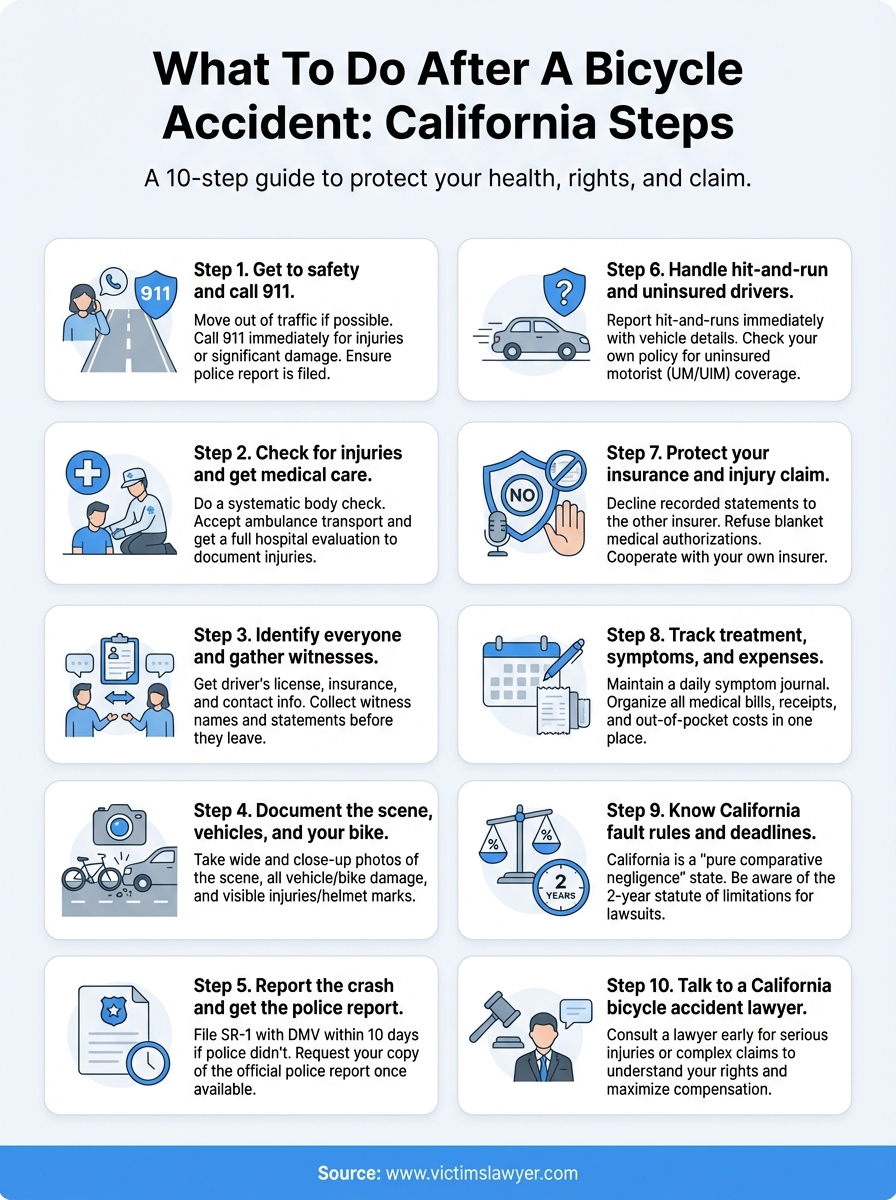
Next steps
Following these steps in what to do after a bicycle accident protects your health, your rights, and your financial recovery. Each action you take immediately after the collision strengthens your ability to hold the at-fault driver accountable and secure fair compensation for your injuries. Documentation creates evidence that insurance companies cannot dispute, medical treatment establishes the severity of your harm, and legal guidance prevents you from making mistakes that destroy your claim’s value.
Your recovery deserves full compensation for medical expenses, lost wages, pain and suffering, and future damages that will affect you for years to come. Insurance companies count on injured cyclists accepting quick settlements before understanding the true cost of their injuries. Don’t let adjusters pressure you into settling for less than you deserve.
Steven M. Sweat, Personal Injury Lawyers, APC has spent over 25 years fighting for injured cyclists throughout California. We offer free consultations 24/7, work on contingency (no fees unless we win), and come to you if your injuries prevent travel. Contact our Los Angeles bicycle accident attorneys today to discuss your case and protect your right to full compensation.