- Free Consultation: 866-966-5240 Tap Here To Call Us













How Is Pain And Suffering Calculated? Multiplier Vs Per Diem


After an accident, medical bills and lost wages are relatively straightforward to document. But what about the sleepless nights, the anxiety before getting back behind the wheel, or the chronic pain that lingers for months? These experiences have real value, and understanding how pain and suffering is calculated can mean the difference between a lowball settlement and fair compensation for everything you’ve endured.
Insurance adjusters use specific formulas to assign dollar amounts to your non-economic damages, and those calculations directly impact your settlement offer. The two primary methods are the Multiplier approach and the Per Diem approach, each with distinct advantages depending on your case circumstances. Knowing how these formulas work puts you in a stronger position when negotiating with insurers who often minimize what you’re owed.
At Steven M. Sweat, Personal Injury Lawyers, APC, we’ve spent over 25 years helping accident victims across California recover hundreds of millions of dollars in verdicts and settlements. This guide breaks down both calculation methods so you can understand what your claim may be worth, and why having an experienced trial attorney matters when insurance companies refuse to pay fairly.
Why pain and suffering damages matter
Your economic losses after an accident include tangible expenses like hospital bills, prescription costs, and paychecks you missed while recovering. But these numbers tell only part of your story. Pain and suffering damages compensate you for the physical discomfort, emotional distress, and diminished quality of life that no medical invoice can quantify. Without this component, your settlement would ignore months of chronic pain, the anxiety that now accompanies simple tasks, or the relationships strained by your injuries.
Insurance companies prefer to focus exclusively on your economic damages because they’re easier to minimize. They’ll argue that your medical bills were inflated or that you could have returned to work sooner. Non-economic damages represent the human cost of what happened to you, and adjusters know these amounts are harder to dispute when properly documented. California law recognizes that your suffering has real value, which is why understanding how pain and suffering is calculated protects you from accepting an inadequate offer that only covers your bills.
The financial gap between bills and real losses
Consider a scenario where you suffered a fractured vertebra in a rear-end collision. Your medical treatment costs $47,000, and you lost $12,000 in wages during recovery. Those $59,000 in economic damages are straightforward to prove with receipts and pay stubs. But what about the six months you spent unable to pick up your children, the chronic back pain that wakes you at night, or the fear you now feel in traffic? These experiences carry significant value that should increase your total recovery substantially.
Pain and suffering damages typically represent the largest portion of your settlement in serious injury cases, often doubling or tripling your economic losses depending on severity.
Most personal injury settlements in California include pain and suffering as 40% to 60% of the total award in moderate to severe cases. When you settle for economic damages alone, you’re essentially telling the insurance company that your physical pain and emotional trauma have no worth. This approach leaves money on the table that you legally deserve and may desperately need for future treatment or adaptation to permanent limitations.
How settlements break down in California injury cases
Your total compensation package consists of two main categories. Economic damages cover your out-of-pocket losses: past and future medical expenses, lost earnings, reduced earning capacity, and property damage. These amounts come with documentation that insurers can verify. Non-economic damages address your pain, suffering, loss of enjoyment of life, emotional distress, and physical limitations that persist after medical treatment ends.

The relationship between these two categories determines your settlement value. A victim with $30,000 in medical bills but catastrophic injuries like paralysis might receive $300,000 or more in pain and suffering damages because the life-altering impact justifies a higher multiplier. Conversely, someone with $30,000 in bills from a fully healed broken arm might receive $60,000 to $90,000 in total compensation because the temporary nature of their suffering warrants a lower calculation. Understanding this dynamic helps you evaluate whether a settlement offer fairly accounts for everything you’ve endured.
What counts as pain and suffering in California
California law recognizes two distinct categories of non-economic damages that fall under the pain and suffering umbrella. Physical pain and suffering includes the actual bodily discomfort you experience from your injuries, whether that’s sharp pain from broken bones, throbbing headaches after a concussion, or burning sensations from nerve damage. Mental and emotional suffering encompasses the psychological toll of your accident, including anxiety, depression, loss of enjoyment of activities you once loved, and the distress caused by disfigurement or disability. Both categories carry equal weight when determining how pain and suffering is calculated in your settlement.
Physical pain and limitations
Your physical suffering extends beyond the immediate aftermath of your accident. Courts and insurance adjusters consider the intensity of your pain, the duration of your recovery, and whether you face permanent limitations. A herniated disc that causes shooting pain down your leg for two years holds more value than a sprained wrist that heals in six weeks. Chronic conditions that require ongoing pain management, physical therapy, or surgical interventions demonstrate sustained suffering that justifies higher compensation.
Permanent physical restrictions also factor into your claim value. If you can no longer lift objects over twenty pounds due to a shoulder injury, or if arthritis now plagues a previously fractured joint, these lasting impairments reduce your quality of life indefinitely. Your ability to work, exercise, or perform household tasks directly impacts the multiplier or per diem rate applied to your case.
Emotional and psychological impacts
Insurance companies often underestimate the mental toll of serious injuries. Post-traumatic stress disorder following a violent collision, depression stemming from disfiguring scars, or anxiety about future medical procedures all constitute compensable suffering. You don’t need a formal psychiatric diagnosis to claim emotional distress, though documented mental health treatment strengthens your case substantially.
California courts recognize that psychological injuries can be just as debilitating as physical wounds, particularly when trauma prevents you from returning to your normal routine.
Loss of consortium claims also fall under this category when injuries strain your relationship with your spouse. Inability to participate in family activities, intimacy, or shared hobbies represents real damage that extends beyond your individual experience. https://www.youtube.com/embed/ZTqozB055ag
How insurers and lawyers use the multiplier method
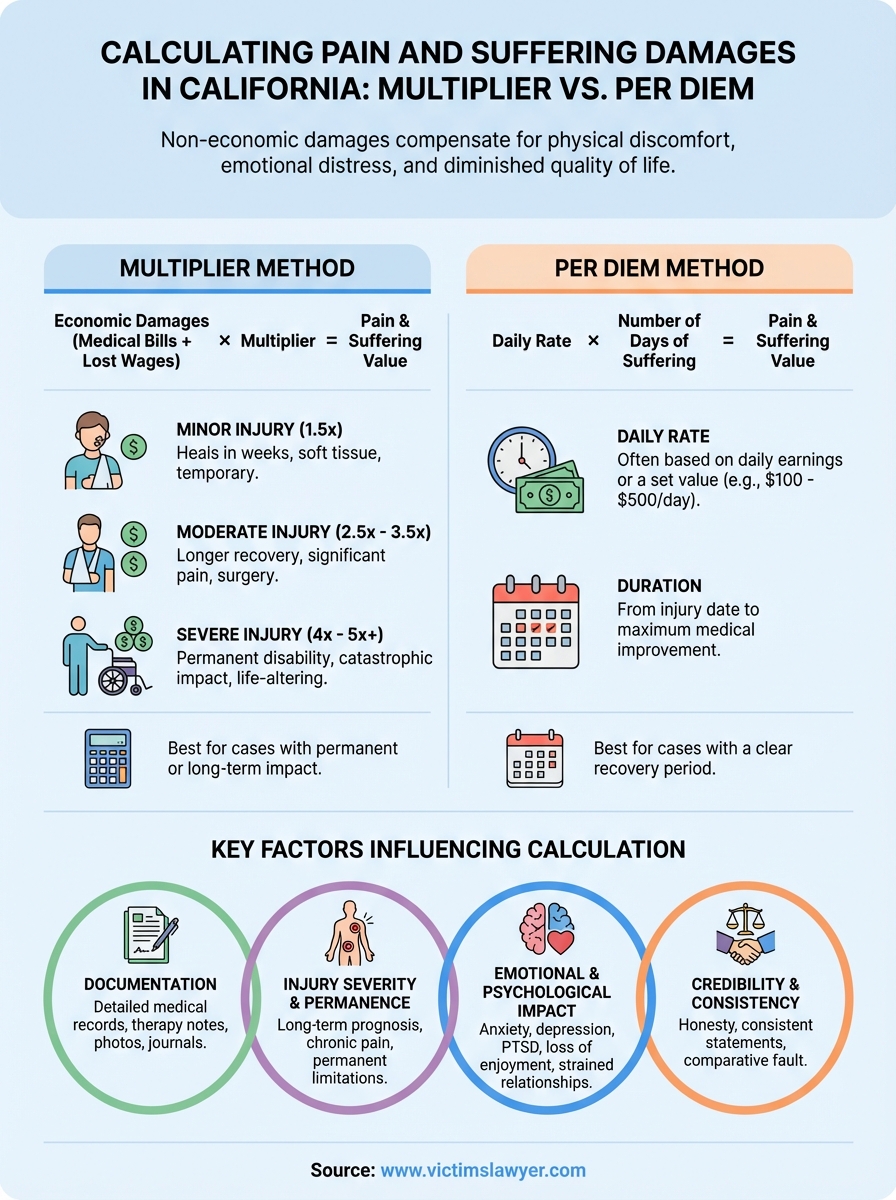
The multiplier method remains the most common approach for determining how pain and suffering is calculated in personal injury settlements. This formula takes your total economic damages (medical bills plus lost wages) and multiplies that sum by a number typically ranging from 1.5 to 5, depending on the severity of your injuries. If you incurred $50,000 in medical expenses and lost $10,000 in wages, your economic damages total $60,000. An adjuster applying a multiplier of 3 would value your pain and suffering at $180,000, bringing your total settlement to $240,000.
Insurance companies prefer this method because it creates a standardized framework that appears objective, though the multiplier chosen involves significant negotiation. Your attorney’s job centers on proving why your case deserves a higher multiplier rather than the lower end of the scale. Adjusters start with conservative numbers to protect their company’s bottom line, which is why having an experienced trial lawyer often doubles or triples what you receive compared to unrepresented claimants.
The multiplier scale and what drives it
Minor injuries that heal completely within weeks typically receive multipliers between 1.5 and 2. These cases involve soft tissue damage, minor fractures, or temporary conditions that don’t leave lasting effects. Your moderate injuries like herniated discs, significant scarring, or injuries requiring surgery usually justify multipliers of 2.5 to 3.5 because they involve substantial pain and longer recovery periods.
Catastrophic injuries command the highest multipliers of 4 to 5 or beyond when you suffer permanent disability, traumatic brain injury, spinal cord damage, or life-altering disfigurement. The severity of your initial trauma, the invasiveness of your treatment, the duration of your recovery, and the permanence of your limitations all influence which number applies to your case.
Adjusters won’t voluntarily offer you a higher multiplier without documented evidence of your suffering and its impact on your daily life.
Real calculation examples
Consider a motorcycle accident victim with $80,000 in medical bills and $20,000 in lost income. Their $100,000 in economic damages multiplied by 2 (for moderate injuries) yields $200,000 in pain and suffering, totaling $300,000. If that same victim suffered paralysis, a multiplier of 5 would calculate $500,000 in pain and suffering for a $600,000 total settlement.
How the per diem method works and when it fits
The per diem approach offers an alternative way to calculate your pain and suffering compensation by assigning a daily dollar value to your suffering from the date of injury until you reach maximum medical improvement. Instead of multiplying your economic damages, this method uses your daily wage or another reasonable figure (often $100 to $500 per day depending on injury severity) and multiplies it by the number of days you experienced pain. If you earn $200 daily and suffered for 365 days, your pain and suffering damages would total $73,000 under this formula.

The daily rate calculation
Attorneys typically base your per diem rate on your actual daily earnings because courts recognize that if you’re paid a certain amount for eight hours of work, your time spent suffering deserves comparable compensation. Someone earning $50,000 annually ($137 per day) might use that figure as their baseline, while higher earners could justify rates of $300 or more. Your lawyer must defend this rate to the insurance adjuster by explaining why your specific circumstances warrant that daily value rather than a lower amount the insurer might propose.
The per diem method works best when you can clearly document the start and end dates of your recovery period with medical records.
Adjusters scrutinize the number of days you claim just as closely as the rate. Your treatment records, prescription dates, and physician notes about your recovery progress establish the timeline. If you continued working throughout your injury, insurers argue that your suffering was less severe and push for fewer compensable days or a reduced daily rate.
When per diem works better than multipliers
This method proves particularly effective for moderate injuries with clear recovery periods rather than catastrophic cases with permanent disability. A broken collarbone that heals in four months presents an easier per diem argument than lifelong paralysis, where how pain and suffering is calculated may require the multiplier approach to capture ongoing impacts. Per diem calculations also appeal to juries because they translate abstract suffering into concrete daily amounts that feel logical and fair, which strengthens your negotiating position when settlement talks stall.
What changes the number: key factors and proof
The multiplier or per diem rate you receive depends on specific variables that insurance adjusters and attorneys evaluate when determining your settlement value. Your age, pre-existing conditions, credibility, and the quality of your documentation all influence whether you receive the low end or high end of the compensation range. Understanding these factors helps you strengthen your claim before negotiations begin and prevents insurers from using weak arguments to reduce what you deserve.
Injury severity and permanence
Your long-term prognosis carries more weight than the initial trauma when calculating pain and suffering damages. An injury requiring three surgeries over two years demonstrates greater suffering than one corrected with a single outpatient procedure. Permanent disabilities like chronic pain, limited range of motion, or visible scarring automatically push your multiplier higher because these conditions affect you for decades rather than months. Medical records showing ongoing treatment, specialist referrals, and physical therapy sessions prove your injuries didn’t resolve quickly as insurers often claim.
Objective medical findings from MRIs, X-rays, and physician examinations hold far more value than your subjective complaints when proving the extent of your suffering.
Documentation and consistency
Insurance adjusters scrutinize your treatment history for gaps that suggest your injuries weren’t serious. Missing appointments, refusing recommended procedures, or delaying care gives them ammunition to argue you’re exaggerating your pain. Your detailed medical records, prescription logs, and therapy notes create an undeniable timeline of suffering that justifies higher compensation. Photographs of visible injuries, journals documenting daily pain levels, and testimony from family members about lifestyle changes further strengthen how pain and suffering is calculated in your favor.
Comparative fault and credibility
California’s comparative negligence rules reduce your settlement by your percentage of fault. If you were 20% responsible for the accident, your total award drops by that same proportion regardless of your suffering level. Your honesty during depositions and consistency between statements also affects your credibility. Adjusters compare what you told police, wrote in medical intake forms, and testified during discovery to find contradictions they’ll use to lower your payout or deny your claim entirely.
What to do next
Understanding how pain and suffering is calculated gives you the foundation to evaluate settlement offers, but insurance adjusters still hold the advantage when you negotiate alone. They know which documentation weaknesses to exploit, which medical gaps to highlight, and which multipliers to defend as “industry standard.” Your best protection comes from an attorney who has spent decades countering these tactics in California courtrooms and securing maximum compensation for clients facing similar injuries.
At Steven M. Sweat, Personal Injury Lawyers, APC, we’ve recovered hundreds of millions of dollars by proving the true value of our clients’ suffering rather than accepting insurer lowball offers. Our free consultation carries no obligation and gives you immediate clarity on what your case may be worth under both calculation methods. We work on contingency, meaning you pay nothing unless we win your settlement or verdict. Contact our Los Angeles personal injury lawyers today to discuss your accident and stop leaving money on the table.